LIRR to Citi Field: The Complete 2026 Guide (And When the Train Isn’t Actually Your Best Option)
July 11, 2026
LaGuardia Airport to Times Square: The Complete 2026 Travel Guide
July 13, 2026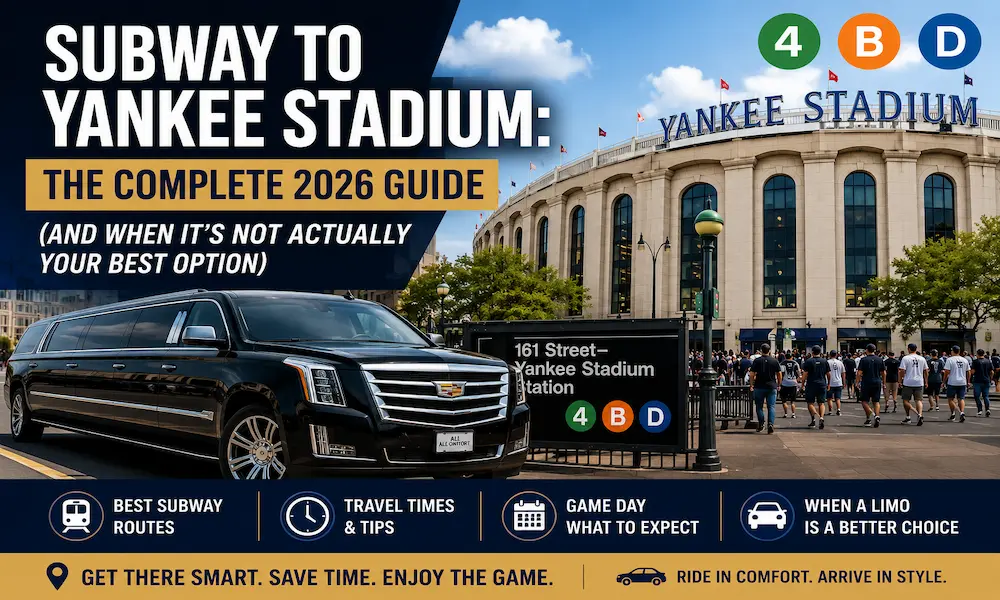
If you’re heading to a Yankees game and just want the short answer: take the 4 or D train to 161st Street–Yankee Stadium. The station sits directly across the street from Gate 6, the ride from Midtown Manhattan takes roughly 15 to 20 minutes depending on where you board, and it’s one of the most direct stadium-to-subway connections in the entire city. That part genuinely is easy.
What most guides skip is everything that happens around that trip — which train to actually pick when both the 4 and D stop nearby, what a $3 fare really covers now that MetroCard is gone, and what it’s like standing on that platform with 40,000 other people the second the final out is recorded. We pulled this together after going through the MTA’s own stadium guidance, the Yankees’ official transit page, and a stack of fan reports from recent games, so you’re getting the version that actually matches game night, not just the textbook route.
Which Subway Lines Actually Stop at Yankee Stadium
Two lines get you right to the ballpark, plus a third that helps on weekdays:
- 4 train (Lexington Avenue Line): Runs up the East Side of Manhattan through Union Square, Grand Central, and 86th Street before crossing into the Bronx.
- D train (Sixth Avenue Line): Runs up the West Side through Rockefeller Center, Columbus Circle, and the Upper West Side.
- B train (Sixth Avenue Line): Also stops at the stadium, but only during weekday service — skip this one for weekend or evening games.
All three stop at 161st Street–Yankee Stadium, which sits on East 161st Street and River Avenue. Step off the platform, follow the crowd, and the stadium’s Gate 6 entrance is essentially right there — no shuttle, no long walk, no guessing which exit to use.
Getting There From Wherever You’re Actually Starting
Not everyone is boarding at the same stop, so here’s how the trip breaks down depending on where you’re coming from.
From Midtown or Grand Central: Board the 4 train and you’re looking at around 15 to 18 minutes with no transfer. This is the fastest and most direct route into the ballpark.
From the Upper West Side (around 86th Street): The D train gets you there in roughly 13 to 14 minutes, making just a handful of stops before the Bronx.
From Downtown or Brooklyn: You’ll ride the 4 or D up through Manhattan first, which adds time depending on your starting station, but it’s still a single, no-transfer ride once you’re on the right line.
From Queens: There’s no direct line from most of Queens, so the typical route is transferring into Manhattan first, then catching the 4 or D north. Build in extra time for the transfer.
From New Jersey: NJ Transit or PATH into Manhattan, then a transfer to the 4 or D. It’s a longer trip with a connection, so plan around it rather than assuming a quick hop.
From Connecticut or Westchester: This is where the subway alone stops being the efficient option. Metro-North’s Hudson Line runs directly to Yankees–East 153rd Street, about a 15-minute ride from Grand Central, which is often faster than riding the subway the whole way if you’re already coming in from the north.
If you’re flying in specifically for a game, it’s worth mapping the entire trip rather than just the last leg to the stadium. Fans landing at JFK sometimes underestimate how much longer the AirTrain-to-subway combination takes with luggage; our JFK to Manhattan transportation guide breaks down what that connection actually looks like before you even get to the ballpark leg.
What You’ll Actually Pay in 2026
MetroCard is gone. As of 2026, every subway and local bus ride runs on OMNY, the tap-and-go system — you tap a contactless card, phone, or OMNY Card at the turnstile, and the base fare is $3 per ride. There’s no separate stadium surcharge; it’s the same flat fare whether you’re riding one stop or twenty.
One detail that actually helps: OMNY automatically caps your spending at $35 in any rolling 7-day period. So if you’re catching a weekend series or planning multiple games, you might hit unlimited-ride territory without doing anything except tapping the same card each time.
For a family of four making a round trip to a single game, that’s still $24 in fares before anyone buys a hot dog — a number people underestimate when they assume “the subway is basically free.”
Game Day Timing: What the Schedule Actually Looks Like
Getting to the stadium is easy to plan around, since you control when you leave. Getting out is a different story.
The Yankees and MTA run additional service around game times, including extra 4 and D trains after the final out, and on evening or weekend games, special Yankee Clipper trains run directly to Yankees–East 153rd Street on the Harlem and Hudson lines from Metro-North territory. That’s a genuinely useful option if you’re coming from the suburbs and don’t want to deal with Grand Central transfers.
Here’s the part that doesn’t show up in most transit guides: the moment a game ends, the 161st Street platform fills up fast. With a capacity crowd, you’re looking at a compressed 20-to-30-minute window where thousands of fans are trying to board the same handful of trains. If the game runs into extra innings or a late rally keeps everyone in their seats until the last pitch, that crowd only gets bigger by the time you reach the platform.
Buses, If You’re Not Near a Subway Stop
Several NYC bus routes also serve the stadium directly: the Bx6 and Bx13 stop at East 161st Street and River Avenue, the Bx1 and Bx2 stop nearby at the Grand Concourse, and the express BxM4 serves the same corridor. These are worth knowing if your starting point is a short bus ride from a subway line but not walking distance to one.
When the Subway Makes Sense, and When It Doesn’t
The subway works well if you’re coming solo or as a pair from somewhere directly on the 4 or D line, you don’t mind standing in a packed crowd for the walk out, and you’re not carrying much beyond a bag. It’s cheap, it’s fast getting in, and there’s genuinely no easier way to reach the stadium door-to-door for the price.
It starts to make less sense in a few specific situations: if you’re traveling with young kids who’ll be worn out by the seventh-inning stretch, if you’ve got a group of six or more trying to stay together on a packed platform after the game, if you’re coming from Connecticut, New Jersey, or somewhere with multiple connections each way, or if you’re hosting clients and want the night to feel effortless instead of like a logistics exercise. That’s usually the point where people start looking at a private ride instead.
Planning a group outing to the Bronx and want the ride sorted before game day? Book your Yankee Stadium car service now and skip the platform entirely.
The Other Ways to Get There
Driving and parking: The Yankee Stadium garages fill up fast on big nights, and premium spots often require a prepaid pass purchased in advance. Add pregame traffic on the Major Deegan Expressway and a postgame exit that can easily take 30-plus minutes to clear the lot, and driving frequently costs more time than the subway saves.
Rideshare: Uber and Lyft do serve the area, but surge pricing after a sold-out game or a Subway Series matchup routinely pushes fares well above normal, and you’re competing with the entire stadium crowd for a limited pickup zone.
Metro-North: A strong option if you’re coming from the northern suburbs, Connecticut, or Westchester, especially with Yankee Clipper service running direct to Yankees–East 153rd Street on game days.
Private car or limo service: This is where a lot of regular ticket holders end up once they’ve done the subway-and-crowd routine a few times. A booked ride gets you dropped and picked up at a set time and location — no platform crush, no surge pricing, no hunting for parking.
Subway vs. Metro-North vs. Driving vs. Car Service
| Option | Typical Cost (round trip, per person) | Travel Time from Midtown | Post-Game Wait | Best For |
|---|---|---|---|---|
| Subway (4 or D) | $6 | 15–20 min | Can be 20–30+ min in a crowd | Solo riders, pairs, budget trips |
| Metro-North (Yankee Clipper) | Varies by origin | 15 min from Grand Central | Extra trains, still crowded | Suburban/CT commuters |
| Driving + Parking | $50–$70+ (parking alone) | 20–40 min depending on traffic | 30–45 min to exit lot | Fans who need a car anyway |
| Rideshare | $25–$70+ (surge-dependent) | 20–35 min | Long waits, surge pricing | Small groups on off-peak nights |
| Private Car/Limo Service | Flat rate, no surge | 20–35 min, scheduled | None, driver waits for you | Families, groups, corporate clients, big games |
The subway wins on pure cost for a solo rider. It loses ground the moment you’re traveling as a family, a group, or you’d rather not spend twenty minutes standing on a crowded platform after a walk-off win.
Why Groups and Families Increasingly Book a Car Instead
A family with two young kids doesn’t want to navigate a packed platform at 10:30 at night after extra innings. A group of eight friends doesn’t want to split across multiple subway cars because they can’t all fit through the turnstiles together. A business hosting a client for a suite night wants the evening to feel effortless from the moment the car pulls up.
That’s the real appeal of booking a ride to Yankee Stadium directly. You get picked up from wherever you actually are — since the stadium sits in the Bronx, a lot of fans coming from Manhattan, Long Island, or Connecticut appreciate not having to figure out a transfer at all — and dropped right near Gate 6. After the game, your driver is already there.
For families with a toddler in tow, comfort matters as much as convenience. If you need a properly installed car seat, it’s worth checking our baby car seat limo service guide before you book, since not every service handles that correctly.
If you’re trying to work out how many people can actually fit together, our breakdown of how many people a limo seats walks through real vehicle capacity so you’re not stuffing six people into a car built for four.
Flying in for the Game? Airport Transfers to the Stadium
A good number of Yankee Stadium visitors, especially for postseason games or a Subway Series weekend, are flying into New York specifically for it. If that’s you, your ride should start the moment you land, not after you’ve already dealt with an AirTrain and two subway transfers with a suitcase.
We run direct chauffeur transfers from JFK, LaGuardia, and Newark straight to the Bronx, with flight tracking built in so pickup adjusts automatically if your flight’s delayed. Our car service from JFK page and our Newark Airport to NYC guide cover typical drive times and what to expect at arrivals, so you can plan the whole trip instead of just the last mile.
Corporate Suites and Client Entertainment
Yankee Stadium hosts a steady stream of corporate suite nights and client outings, and those trips come with different needs than a casual fan visiting solo. Punctuality matters more, groups often split across pickup addresses, and the vehicle itself is part of the impression you’re making on a guest.
If you’re coordinating transportation for a client event or a team outing at the stadium, our corporate travel service handles multi-stop scheduling and invoicing for the whole group, applying the same standard we use for daily business logistics accounts to a single high-visibility game night.
What Actually Affects Your Price
Vehicle type is the biggest factor — a sedan will always run cheaper per trip than a Sprinter van or stretch limo simply because of seating capacity.
Distance and time of day matter next. A pickup from nearby Manhattan costs less than a transfer from Westchester or the Hamptons, and rides during rush hour or right after a sold-out game naturally take longer.
Event demand is the variable people forget about. Marquee matchups like a Yankees–Red Sox series or a postseason game increase demand across every car service in the city, so booking early protects your preferred vehicle.
If you want exact numbers before committing, our guides on how much it costs to rent a limo and hourly limousine pricing lay out real 2026 rate ranges by vehicle class.
Want a locked-in price before the next home series sells out? Reserve your Yankee Stadium ride today and have your chauffeur confirmed before you leave the house.
How Booking Actually Works
Booking a ride to Yankee Stadium shouldn’t take longer than ordering dinner. You pick your date, game, and pickup location, choose a vehicle size that fits your group, and get a confirmed price instantly — no back-and-forth quote requests. For high-demand nights like a rivalry series or a playoff game, booking a day or two ahead guarantees you get the exact vehicle class you want rather than whatever’s left.
Frequently Asked Questions
Which subway train goes to Yankee Stadium?
The 4 and D trains both stop directly at 161st Street–Yankee Stadium, right across from Gate 6. The B train also stops there, but only on weekdays.
How long does the subway take to Yankee Stadium from Midtown?
About 15 to 18 minutes on the 4 train from Grand Central, or 13 to 14 minutes on the D train from the Upper West Side, depending on your exact starting station.
How much does the subway cost to Yankee Stadium in 2026?
The base OMNY fare is $3 per ride, tapped with a contactless card, phone, or OMNY Card. There’s a rolling weekly cap of $35, so frequent riders in the same 7-day window may end up paying less per trip.
What’s the best way to avoid the crowd after a Yankees game?
Leaving a few minutes before the final out helps a little, but the more reliable fix is booking a private car with a scheduled pickup, since your driver waits for you instead of you waiting in a packed platform crowd.
Is Metro-North better than the subway for getting to Yankee Stadium?
For fans coming from Connecticut or the northern suburbs, yes — Metro-North’s Yankee Clipper trains run directly to Yankees–East 153rd Street and often skip the transfer the subway would require.
Can I book a car service to Yankee Stadium for a large group?
Yes. Vehicles range from sedans for two or three passengers up to Sprinter vans and stretch limos for larger groups, so you’re not forced to split across multiple rides.
Getting to the Game Should Be the Easy Part
The subway genuinely is the fastest, cheapest way into Yankee Stadium for a solo rider or a pair coming from anywhere near the 4 or D line. It gets a lot less appealing once you add a family, a group, or a late-inning finish that leaves you standing on a jammed platform waiting for room to board. If you’d rather skip that part entirely, book a ride with All Comfort Limo and get picked up from your door and dropped right at the gate — no transfers, no surge pricing, no standing around after the last out. Browse our fleet options to find the right fit for your group, or reach out to our team if you’re planning transportation for a whole day out in the Bronx, a Subway Series weekend, or any other game on this season’s schedule.