

Things to Do Near the 9/11 Memorial: A Local’s Guide to Lower Manhattan
July 23, 2026
Things to Do in Hartford, CT: The Complete 2026 Local’s Guide
July 25, 2026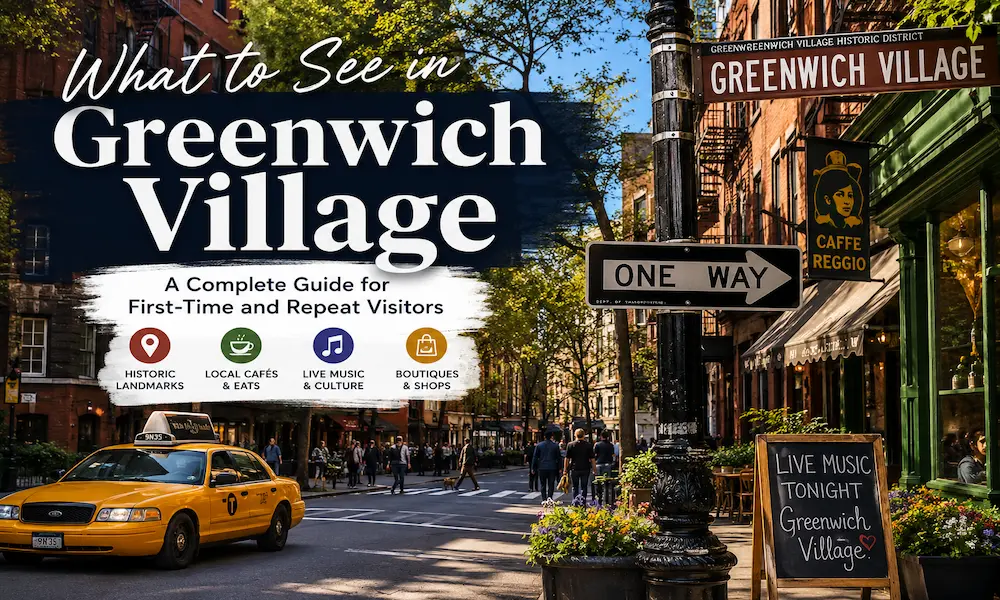
Greenwich Village doesn’t look like the rest of Manhattan, and that’s the whole point. The streets bend and cross at odd angles instead of following the city grid, the buildings top out at four or five stories instead of forty, and there’s a quiet, lived-in charm here that feels almost accidental in a city built for spectacle. If you’re wondering what to see in Greenwich Village, the short answer is: more than you’ll fit into one trip. But a few places genuinely earn a spot on your list, and the rest depends on whether you’re chasing history, food, music, or just a good afternoon of wandering.
This guide walks through the neighborhood the way a local would show a friend around, starting with the essentials and working outward into the corners most visitors miss entirely.
Quick Answer: The Best Things to See in Greenwich Village
If you only have a few hours, prioritize these: Washington Square Park, Bleecker Street, the Stonewall National Monument, Christopher Street, and at least one jazz club in the evening. Add Grove Court and Patchin Place if you enjoy quiet, photogenic side streets, and stop at Murray’s Cheese or Caffe Reggio for a real taste of the neighborhood’s food culture. Most of this is walkable in a single loop of two to three hours, though the Village rewards a slower pace.
Now let’s get into why each of these matters, plus a handful of spots most guides skip.
Washington Square Park: Where the Village Begins
Almost every walk through the Village starts here, and for good reason. Washington Square Park sits at the foot of Fifth Avenue and has been the neighborhood’s social center since it opened as a public park in 1827, long before that in fact, as a potter’s field and military parade ground. The marble arch at the northern entrance was built in 1892 to honor George Washington, and it’s become one of the most photographed landmarks in Lower Manhattan.
What makes the park worth visiting isn’t just the arch, though. It’s the constant motion around it. Street musicians set up near the fountain most afternoons, NYU students cut through on their way to class since the park sits at the heart of the university’s campus, and chess players hold court at the stone tables along the southwest corner, ready to challenge anyone who sits down. In warmer months, the central fountain becomes an unofficial gathering spot, and in December the enormous Christmas tree near the arch draws its own crowd.
Compared to Central Park’s 840 acres, Washington Square is small, under 10 acres, but it packs in more daily life per square foot than almost any other green space in the city.
Bleecker Street: From Bohemia to Boutiques
Bleecker Street runs through the heart of the Village and has changed more than almost any other street in the neighborhood. It was once lined with folk clubs and record stores where a young Bob Dylan played his first New York gigs. Today the stretch through the West Village leans more upscale, with designer boutiques, small galleries, and a steady rotation of restaurants replacing most of the old music venues.
That said, the food is where Bleecker Street still holds its own. Murray’s Cheese has been operating near the corner of Bleecker and Cornelia since 1940 and remains one of the best cheese shops in the country, with a tasting counter if you want to sample before you buy. A few blocks down, John’s of Bleecker Street has been serving coal-oven pizza since 1929, and locals will tell you it’s one of the few places in the city where the crust actually earns the hype.
If you’re planning a longer day of exploring multiple Manhattan neighborhoods in one trip, it helps to have a set schedule instead of hunting for parking or waiting on rideshares between stops. A lot of visitors booking a Manhattan car service build in a Village stop alongside SoHo or Chelsea since they’re all within a short drive of each other.
Christopher Street and the Stonewall National Monument
No honest answer to “what to see in Greenwich Village” skips this one. Christopher Street is the heart of the neighborhood’s identity as a center of LGBTQ+ history and culture, and the Stonewall Inn, still an operating bar today, is where the 1969 uprising sparked the modern gay rights movement in the United States. In 2016, the surrounding area was designated the Stonewall National Monument, the first U.S. national monument dedicated to LGBTQ+ history.
The site itself is understated. There’s no massive visitor center or long line, just a small park across the street, a plaque, and the bar itself with its original signage largely intact. That’s part of what makes it powerful. Standing there gives you a clearer sense of the Village’s role in American civil rights history than any museum exhibit could.
The Hidden Streets: Grove Court, Patchin Place, and Gay Street
This is where the Village rewards people who wander off the main routes.
Grove Court is a small cul-de-sac tucked behind an iron gate on Grove Street, lined with brick row houses from the 1850s. It’s private property, so you can’t walk in, but you can see it clearly from the sidewalk, and it looks almost nothing like the rest of Manhattan.
Patchin Place is a gated mews just off Sixth Avenue where writers including E.E. Cummings and Djuna Barnes once lived. It’s easy to walk right past it if you’re not looking, which is exactly why so few tourists ever find it.
Gay Street is a short, crooked block that curves unexpectedly between two larger streets, lined with small 19th-century houses. It’s one of the most photographed residential streets in the neighborhood, and it takes about ninety seconds to walk the whole thing, which somehow makes it feel even more like a secret.
None of these three are destinations on their own. Together, they’re the difference between seeing the Village and actually understanding what makes it different from the rest of the city.
Jazz Clubs and Live Music
The Village has been a music neighborhood for a century, and it still delivers if you know where to look.
Village Vanguard, open since 1935, is one of the most historically important jazz venues in the world. Nearly every major jazz musician of the last ninety years has played there, and the room itself, small, wedge-shaped, and slightly cramped, is part of the experience.
Blue Note is the more polished, better-known option a few blocks away, drawing bigger touring acts and a livelier crowd.
For something smaller and more intimate, Smalls Jazz Club on West 10th Street runs sets late into the night in a basement space that feels closer to a speakeasy than a concert hall.
If your evening plans include a show, it’s worth checking set times in advance since most Village clubs run two seats a night and sell out quickly on weekends.
Food and Coffee Worth Planning Around
Beyond Murray’s Cheese and John’s Pizzeria, a few spots consistently come up when locals talk about where to eat in the Village.
Caffè Reggio on MacDougal Street claims to have introduced the cappuccino to America and has been open since 1927. The interior still has much of its original décor, including a bench once owned by the Medici family, which sounds like an exaggeration until you see it.
Minetta Tavern, tucked on a quiet street near Washington Square, has been serving since 1937 and is now known almost as much for its burger as its history as a Prohibition-era speakeasy.
For something more casual, the Village has one of the highest concentrations of small independent bakeries and coffee shops in Manhattan, many of them family-run for two or three generations.
Architecture and Quiet Corners
The Village’s architecture is a big part of why it feels different from the rest of the city, and a few buildings are worth a slower look.
The Jefferson Market Library, with its distinctive red-brick clock tower on Sixth Avenue, was originally an 1877 courthouse before becoming a public library in the 1960s. Right behind it, Jefferson Market Garden is a small, quiet green space that most visitors never notice, run by volunteers on what used to be a women’s prison site.
The Church of the Ascension on Fifth Avenue is worth a look for its stained glass and John La Farge murals, and Washington Mews, a private cobblestone lane just north of the park, gives you another look at the old carriage-house architecture that used to be common throughout the neighborhood.
Shopping and Bookstores
The Village has lost a lot of its old record-store culture, but independent bookstores have held on better than almost anywhere else in the city. Three Lives & Company on West 10th Street is a favorite among longtime residents and writers, and it’s the kind of shop where the staff actually know their inventory. Strand Book Store, while technically just outside the Village border near Union Square, is close enough that most walking tours fold it in.
For something less bookish, Bleecker Street and its side streets are lined with small boutiques selling vintage clothing, jewelry, and home goods, most of them independently owned rather than chains.
Best Time to Visit and How to Get There
Greenwich Village works well in every season, but spring and fall are the most comfortable for walking, with mild temperatures and fewer crowds than summer weekends. Summer brings more street performers and outdoor seating but also heat and heavier foot traffic around Washington Square. Winter is quieter and gives you a good chance to see the park’s Christmas tree lit up near the arch.
The neighborhood is served by several subway lines, including the A, C, E, B, D, F, and M at West 4th Street, and the 1 train at Christopher Street. If you’re coming from JFK or Newark, it’s usually easier to arrange transportation in advance rather than juggle transfers with luggage, especially if you’re heading straight into the city after a flight. Our guides on getting from JFK to Manhattan and Newark Airport to NYC cover the full range of options if you’re planning that leg of the trip.
For visitors staying in the city for a few days and wanting to explore several neighborhoods without the hassle of parking or repeated rideshare bookings, an hourly car service can actually work out to be more convenient than it sounds, especially for groups splitting the cost across a full day of sightseeing.
A Simple One-Day Village Itinerary
If you want a loop that covers most of what’s listed above without backtracking too much, this works well:
Morning: Start at Washington Square Park, then walk north to see Washington Mews and the Church of the Ascension.
Midday: Head west along Bleecker Street, stopping at Murray’s Cheese and grabbing a slice at John’s of Bleecker Street.
Afternoon: Wander toward Grove Court, Patchin Place, and Gay Street, then continue to Christopher Street and the Stonewall National Monument.
Evening: Grab dinner near MacDougal Street, then catch a set at Village Vanguard or Blue Note before heading back.
This route covers roughly two to three miles of walking, mostly flat, and takes about five to six hours at a relaxed pace with stops.
Frequently Asked Questions
What is Greenwich Village best known for?
Greenwich Village is best known for its role in New York’s counterculture and arts history, its LGBTQ+ history centered around the Stonewall Inn, and its distinct, low-rise, non-grid streetscape that sets it apart from the rest of Manhattan.
How long does it take to see Greenwich Village?
A focused walking tour covering the main sights takes about two to three hours. A fuller day that includes food stops, a bookstore or two, and an evening show typically runs five to six hours.
Is Greenwich Village worth visiting for first-time NYC visitors?
Yes. It offers a very different experience from Midtown or Times Square, with a slower pace, historic architecture, and a strong food and music scene, making it a good balance to a trip that also includes the more high-energy parts of the city.
What’s the difference between Greenwich Village and the West Village?
The West Village is technically a smaller section within the broader Greenwich Village area, generally considered the portion west of Seventh Avenue. Most visitors use the terms interchangeably since the two blend together with no clear boundary on the ground.
Is Greenwich Village safe to walk around at night?
Yes, it’s generally considered one of the safer and more walkable neighborhoods in Manhattan, especially around the main commercial strips like Bleecker Street and Christopher Street, which stay active into the evening.
Planning Your Visit
Greenwich Village isn’t a neighborhood you check off a list in twenty minutes. It rewards time, and the best version of a visit here usually involves a bit of wandering off whatever route you planned. Whether you’re building this into a longer Manhattan itinerary or making it the centerpiece of your day, having reliable transportation in and out of the neighborhood makes it easier to actually enjoy the walk instead of watching the clock for your next ride.
If you’re coordinating a full day across multiple neighborhoods, or arriving from the airport and want the whole trip handled without the back-and-forth of booking separate rides, you can see our full range of vehicles on the fleet page or go ahead and book your ride now to lock in your schedule ahead of time.