

FIFA World Cup 2026 Limo Service NYC — JFK, LGA & MetLife Stadium Transfers | From $150
June 1, 2026
JFK Airport Transportation to Manhattan: Complete 2026 Guide
June 11, 2026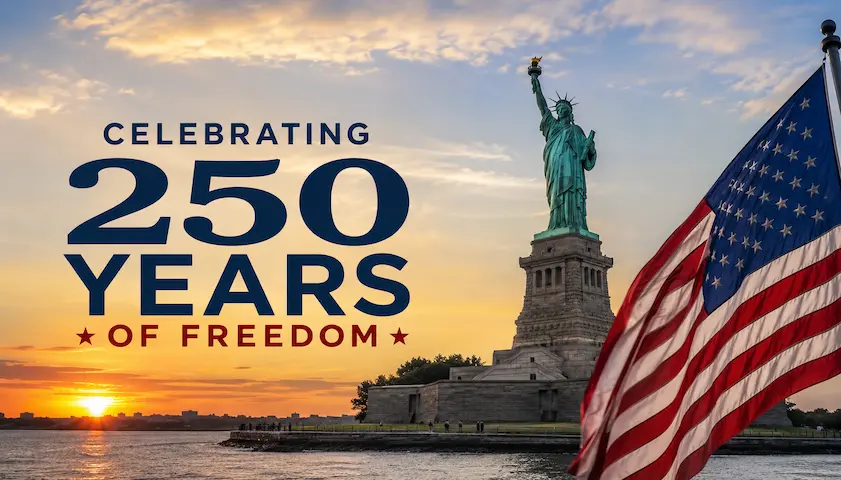
On July 4, 2026, the United States will mark 250 years since the signing of the Declaration of Independence. This is not your routine Independence Day. It is a quarter-millennium milestone, a moment so rare that no living person has witnessed anything like it before, and no one reading this will see it again. Events are unfolding across the country on a scale not seen since the Bicentennial in 1976, and the closer July 4th gets, the more unmistakable it becomes: 2026 is genuinely different.
Whether you are planning to attend a major celebration, traveling to a historic American city, or simply trying to understand what this anniversary actually means beyond the fireworks, this guide gives you everything you need.
What Is the Semiquincentennial and Why Does the Word Matter?
Most people already know America’s birthday is July 4th. What they may not know is that the 250th anniversary carries a formal name: the semiquincentennial. It comes from three Latin roots, semi (half), quin (five), and centennial (one hundred years). Put together, it simply means two and a half centuries. It is a mouthful, but it is the correct term, and in 2026 you will hear it everywhere.
The reason the word matters is that it signals something beyond an anniversary. Every country has birthdays. But a 250th anniversary places a nation in a specific category: it means the constitutional framework established at founding has survived wars, economic collapse, social upheaval, and generational change, and it is still standing. That is not common. It is actually remarkable.
When the Founding Fathers signed the Declaration in Philadelphia in 1776, the United States had roughly 2.5 million people spread across 13 colonies. Today, the country encompasses over 330 million citizens across 50 states and territories stretching from the Arctic to the Pacific. The distance between those two realities, same founding document, entirely different scale, is what the semiquincentennial is really asking Americans to think about.
The Document That Started It All
The Declaration of Independence was not a polite letter to the British Crown. It was a political rupture, one of the most consequential pieces of writing in the history of governance.
Its central argument was radical for 1776: that all men are created equal, that they are endowed with certain unalienable rights, and that governments derive their just powers from the consent of the governed. These were not safe ideas. They were ideas that justified revolution, and they launched one.
What makes the Declaration endure is not that it perfectly described the reality of 1776. It clearly did not, given slavery and the exclusion of women from public life. What makes it endure is that it established an aspirational standard that the country has been reaching toward, imperfectly and unevenly, ever since. The Civil War, the 19th Amendment, the Civil Rights Act — each of these represented the country being held to its own founding promise.
At 250 years old, that process is still ongoing. Which is part of what makes this anniversary worth genuinely reflecting on, rather than simply celebrating with a cold drink and a fireworks show.
Who Is Behind the Nationwide Celebration?
The scale of the 2026 commemoration required years of planning and coordination at every level of government.
Congress established the U.S. Semiquincentennial Commission back in 2016, a full decade before the anniversary, to lead the nationwide coordination. The Commission’s mandate was to make this the largest and most inclusive commemorative observance in American history, involving all 50 states and as many communities as possible.
In January 2025, a White House Executive Order established the Salute to America 250 Task Force, commonly referred to as Task Force 250, which operates in partnership with a public-private initiative called Freedom 250. The Task Force has been coordinating with federal agencies, state and local governments, the private sector, nonprofit organizations, and educational institutions to ensure that the celebration reflects every corner of the country and not just major cities.
The yearlong program of events began on Memorial Day 2025 and is scheduled to run through the end of 2026. The centerpiece, as it has always been, is July 4th itself.
The Signature Events of America’s 250th
Here is a clear overview of the confirmed major events happening as part of the semiquincentennial:
| Event | Location | Date |
|---|---|---|
| Sail4th 250 — International Tall Ship Flotilla | New York Harbor | July 3–9, 2026 |
| Times Square Ball Drop (first-ever outside New Year’s Eve) | New York City | July 3, 2026 |
| Macy’s 50th Annual July 4th Fireworks Display | East River, NYC | July 4, 2026 |
| National Mall Celebration | Washington, D.C. | July 4, 2026 |
| Homecoming of Heroes Veterans Parade | Canyon of Heroes, NYC | July 6, 2026 |
| America’s Block Party | Nationwide | July 3–5, 2026 |
| The Giving 4th Broadcast Benefit Show | Times Square (Livestreamed) | July 4, 2026 |
| The American Story Exhibition | National Archives, D.C. | 2026 |
| Revolution: 1776 and Beyond Exhibition | New York Public Library | June 2026–Jan 2027 |
| U.S. Army Grand Military Parade | Washington, D.C. | 2026 |
| Patriot Games — National High School Athletic Competition | Nationwide | Fall 2026 |
New York City: The Nation’s Largest Stage
New York is carrying more of this celebration than any other city, and it has earned that role. The harbor, the skyline, the city’s own Revolutionary War history — New York was occupied by British forces for most of the Revolutionary War and served as the nation’s first capital. Its connection to 1776 runs deep.
Sail4th 250: 60 Tall Ships in New York Harbor
The most visually stunning event of the entire semiquincentennial will take place in New York Harbor. Sail4th 250 brings 60 international tall ships from more than 20 countries into the harbor for a weeklong celebration running July 3 through 9. The flotilla will be accompanied by dozens of U.S. and allied naval vessels, flyovers by more than 100 aircraft, and free public ship tours throughout the week.
The centerpiece is the International Parade of Sail on July 4th itself, when all the tall ships move through the harbor in formation. Cunard’s Queen Mary 2 will be anchored in the harbor as part of the display. This mirrors similar maritime celebrations held in 1976 and 2000 but is larger than both. The event is expected to draw more than six million visitors to the New York–New Jersey region during that week alone.
The Times Square Ball Drop: A Historic First
On the night of July 3rd, the Times Square Ball will descend for the first time in its history outside of New Year’s Eve. At 11:59 p.m., the ball drops, counting down to America’s 250th birthday. When it reaches the bottom, 2,000 pounds of red, white, and blue confetti will fall on the Crossroads of the World. This is the actual Times Square Ball, not a replica, making its Independence Day debut after more than a century of New Year’s exclusivity.
Macy’s Fireworks: 50 Years and 250 Combined
July 4, 2026 also marks Macy’s 50th annual July 4th fireworks display, a coincidence that adds to the weight of the evening. The display rises over the East River, with barges positioned for maximum visibility across Lower Manhattan. The Blue Angels are expected to perform flyovers as part of the night’s programming. Public viewing areas include the Long Island City waterfront, Roosevelt Island, and the East 34th Street Ferry Landing. Expect every one of these spots to fill hours before the show begins.
Revolution: 1776 and Beyond at the New York Public Library
The New York Public Library is staging one of the most intellectually significant exhibitions of the year. Running from June 2026 through January 2027, Revolution: 1776 and Beyond transforms the marble halls of the Stephen A. Schwarzman Building into a journey through the country’s evolving definitions of freedom, equality, and civic life. From July 1 to 3, visitors can view Thomas Jefferson’s own handwritten copy of the Declaration of Independence, one of the most significant objects in American history, on public display in Manhattan.
The NYC Revolutionary Trail
A free, 90-minute augmented reality walking experience called Echoes of Revolution launches in Lower Manhattan in June 2026. The 3-mile trail uses AR technology, audio narration, and immersive visuals to bring Revolutionary-era New York back to life. It is one of the more creative uses of technology in the semiquincentennial programming and is designed for families and anyone who wants to experience history at street level rather than behind glass.
Homecoming of Heroes: July 6th Parade
On July 6th, the Canyon of Heroes in Lower Manhattan will host the Homecoming of Heroes parade honoring veterans of the Global War on Terror. The timing is intentional: it connects modern service with the military foundations of the republic, and it falls just two days after the nation’s largest birthday celebration.
Washington, D.C.: The Ceremonial Heart
If New York provides the spectacle, Washington provides the ceremony. The National Mall on July 4, 2026 will host what is being described as the largest pyrotechnics display in American history, anchored by a full day of programming that includes keynote remarks by the President, performances by choirs and marching bands, and ceremonies honoring military service members.
More than a million people are expected on the Mall that day. Advance planning for transportation and accommodation is not a suggestion; it is a necessity.
The National Archives is running its own major programming for the semiquincentennial. The Opening the Vault exhibition series shares historically significant artifacts that are rarely shown to the public, and a new exhibit called The American Story brings together original documents, personal histories, and photography to present a comprehensive portrait of American life across 250 years.
Philadelphia: The City That Made It Real
Philadelphia holds a specific authority in this anniversary that no other city can claim. The Declaration was debated, drafted, and signed there. The Liberty Bell rang there. The Constitutional Convention produced the framework of American government in that same city just eleven years after independence.
On July 4, 2026, a national time capsule will be buried at Independence Mall in Philadelphia, a gesture that connects the current generation to an unknown future, the same way the Founders connected their moment to an uncertain future they would never see.
If you want to feel the weight of what July 4, 1776 actually meant, not as abstraction but as physical place, Philadelphia is where you go.
What Makes 2026 Different from Every Other July 4th?
This is the question worth answering directly, because it is the one most people are quietly asking.
Every July 4th has fireworks and cookouts. Most July 4ths have parades. What separates the semiquincentennial from all of them comes down to three things.
Scale. The coordination behind these events is genuinely unprecedented. Events are happening simultaneously in every state, at the federal level, and internationally. The Sail4th flotilla includes ships from more than 20 countries. The National Mall display is being built to be the largest in the country’s history. The Times Square Ball is doing something it has never done in over a century. None of this is routine.
Rarity. A 250th anniversary happens once. The next one is 2276, well beyond any living person’s lifetime. The 1976 Bicentennial is the closest comparison, and many people who were there describe it as one of the most memorable moments of their lives. 2026 is on that level.
Reflection. There is a quality to a 250-year mark that pushes beyond celebration into honest examination. Half a millennium is long enough to see patterns — where the country kept its promises, where it fell short, and what it might yet become. The best semiquincentennial events are designed around that kind of thinking, not just spectacle.
How to Experience the Semiquincentennial: A Practical Planning Guide
Best Cities to Visit
New York City is the top choice for anyone who wants to combine multiple major events in a single trip. The Sail4th 250, Times Square Ball Drop, Macy’s fireworks, the Revolutionary Trail, the New York Public Library exhibition, and the Homecoming of Heroes parade all happen here within days of each other.
Washington, D.C. is the best choice for those who want the most ceremonially significant experience, particularly around the National Archives exhibitions and the National Mall programming on July 4th.
Philadelphia is ideal for history-focused travelers who want to walk the actual ground where the Declaration was debated and signed.
What to Expect on the Ground
Crowds will be exceptionally large by any standard. The July 3 to 6 window in New York City will bring together Sail4th visitors, July 4th celebrants, and tourists from around the world simultaneously. Every major waterfront and public space will operate at or beyond normal capacity.
Book accommodations as early as possible if you have not already done so. Transportation requires planning too. The East River waterfront, Times Square, and Lower Manhattan will experience extraordinary congestion during this window. For those attending a special event tied to the semiquincentennial celebrations in New York, professional ground transportation removes the stress of navigating a city at maximum capacity and lets you focus entirely on the experience.
U.S. Mint Commemorative Coins
One of the quieter but most lasting ways to mark this anniversary is through the official commemorative coins issued by the U.S. Mint. For 2026 only, the circulating dime, quarter, and half dollar feature special semiquincentennial designs. The Mint is also releasing numismatic collector coins and medals with unique engravings specific to this anniversary year. These are legitimate historical artifacts in coin form, and they will not be minted again.
The Deeper Meaning: Freedom at 250
Beyond the fireworks and the tall ships, this anniversary asks something of every American. The Declaration of Independence was not a description of a finished nation. It was a statement of intention, a promise that the people signing it were committed to building something that had never quite existed before.
Two hundred and fifty years later, the country has kept some of that promise and fallen short on other parts. The Civil Rights Act was signed just 62 years ago. Women’s suffrage is barely a century old. These are not distant historical footnotes; they sit within living memory for many Americans.
What the semiquincentennial offers is not uncritical celebration but genuine reflection. The most thoughtful events being organized for 2026 are not designed to paper over complexity. They are designed to hold the founding ideals up alongside the full historical record and ask what comes next.
That framing, past and present and future together, is what separates this milestone from an ordinary holiday. For those who want to go deeper into the primary source material, the National Archives at archives.gov/freedom250 offers founding documents, original records, and exhibition details directly from the institution that preserves the Declaration itself.
Frequently Asked Questions
When is America’s 250th anniversary? July 4, 2026. The Declaration of Independence was adopted on July 4, 1776, making 2026 exactly 250 years later.
What is the semiquincentennial? The official term for a 250th anniversary, derived from Latin roots meaning half of five centuries.
What is America 250? America250 is the official bipartisan initiative coordinating nationwide celebrations for the semiquincentennial, working alongside the White House Task Force 250 and the U.S. Semiquincentennial Commission originally established by Congress in 2016.
What are the biggest events for July 4, 2026? The major confirmed events include the Sail4th 250 tall ship parade in New York Harbor, the historic Times Square Ball Drop on the night of July 3rd, Macy’s 50th annual fireworks display over the East River, the National Mall celebration in Washington D.C., and the Homecoming of Heroes Veterans Parade on July 6th in New York.
Where is the best place to celebrate America’s 250th anniversary? New York City offers the highest concentration of signature events during the July 3 to 6 window. Washington D.C. is the most historically and ceremonially significant location. Philadelphia provides the closest physical connection to the 1776 founding moment.
Is America 250 a bipartisan initiative? Yes. The U.S. Semiquincentennial Commission was established by Congress in 2016 with bipartisan support. The coordination structure involves federal agencies, civic organizations, cultural institutions, and community groups across all 50 states.
How many people are expected at New York City’s events? The Sail4th 250 alone is projected to draw more than six million visitors to the New York–New Jersey region during the July 3 to 9 window.
Are there commemorative coins for America’s 250th? Yes. The U.S. Mint is releasing one-year-only semiquincentennial designs on circulating coins plus special collector coins and medals available only in 2026.