Closest Airport to MetLife Stadium: A Complete Travel Guide
July 19, 2026
Things to Do Near JFK Airport: A Real Guide for However Much Time You’ve Got
July 20, 2026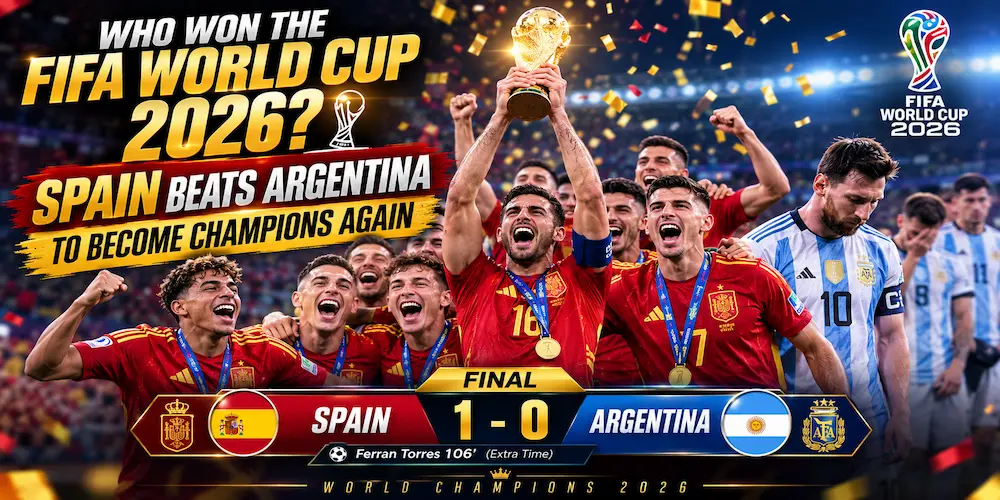
If you’re searching for a quick answer, here it is: Spain won the 2026 FIFA World Cup. La Roja defeated Argentina 1-0 in extra time in the final, played on Sunday night at MetLife Stadium in East Rutherford, New Jersey. Forward Ferran Torres, who had come on as a substitute, scored the only goal of the match, handing Spain its second World Cup title and ending a wait that stretched all the way back to 2010.
For a tournament that expanded to 48 teams for the first time in history, it feels fitting that the final came down to the two best teams in the world by FIFA’s own rankings, playing in front of a crowd that included President Donald Trump and FIFA president Gianni Infantino, who presented the trophy after the match. But numbers and ceremony aside, what actually happened on the pitch was one of the most disciplined, defense-first performances a World Cup final has ever produced. Here’s everything you need to know about how Spain won it, who else walked away with hardware, and what made this final one for the history books.
The Final Score: Spain 1, Argentina 0 (After Extra Time)
Ninety minutes of regulation time came and went without a single goal, and honestly, without a single moment where either side looked close to breaking through. Argentina’s back line held firm against wave after wave of Spanish pressure, with defenders throwing their bodies in front of shots and blocking crosses that seemed destined to find the back of the net. On the other end, goalkeeper Emiliano Martinez, playing through a broken finger on his right hand, kept Argentina in the game with save after save.
It wasn’t until extra time that the deadlock finally broke. Ferran Torres, who had entered the match as a substitute, connected on a goal that sent the Spanish bench into celebration and quieted a stadium packed with fans hoping to see Lionel Messi lift one final trophy for his country. Martinez finished the match with 11 saves, the most ever recorded in a men’s World Cup final, which tells you just how much work Spain put in to finally find that opening.
Argentina, to their credit, never stopped fighting. But for long stretches of the match, they struggled to create anything meaningful going forward. Through halftime of extra time, Argentina had recorded zero shots and only two touches inside Spain’s penalty box, a staggering statistic for a team with this much attacking talent on the roster.
If you’re planning a future trip to catch a match or event at this stadium, it helps to know the venue before you go. This guide on how to get to MetLife Stadium from NYC breaks down every route option, so you’re not scrambling on event day the way tens of thousands of fans were for this final.
Spain’s Road to the Title Was a Defensive Masterclass
What made this Spain team different from most modern World Cup champions wasn’t flair, it was control. Spain became the most dominant defensive champion in tournament history, conceding just a single goal across the entire competition. No team that has ever lifted the World Cup trophy did it while allowing fewer goals.
That’s an even more remarkable feat when you consider the new tournament format required the eventual champion to play eight matches instead of seven, a record for any World Cup winner. More games usually means more chances for something to go wrong defensively. Spain simply refused to let that happen, grinding out wins over four teams ranked inside the world’s top ten along the way.
Spain entered the final unbeaten in 38 consecutive matches, a run that also included their triumph at the 2024 European Championship. That kind of consistency doesn’t happen by accident, and it’s a big part of why this Spanish squad is already being talked about as one of the great international sides of this era.
This was also Spain’s second World Cup title overall. Their first came in 2010, when they defeated the Netherlands in the final in Johannesburg. Sixteen years later, in a stadium roughly 4,700 miles from that first triumph, Spain proved that win wasn’t a one-off.
What Happened to Argentina and Lionel Messi
Argentina came into this tournament as the defending champions from Qatar 2022, and for a nation with three World Cup titles already in the trophy cabinet, from 1978, 1986, and 2022, a fourth would have completed one of the most remarkable back-to-back stretches in football history. It wasn’t meant to be, but this Argentina squad still had a tournament to be proud of.
The semifinal win over England in Atlanta on July 15 was one of the moments of the whole competition. England had actually taken the lead through a goal from Anthony Gordon in the 55th minute, but head coach shifted Argentina into a five-defender setup, made several substitutions, and turned the match around to book their spot in the final.
For Lionel Messi, this tournament carried a different kind of weight. At 39 years old, he finished the competition with 8 goals, just two behind the tournament’s top scorer, and by most accounts, this may have been his final World Cup appearance for Argentina. There’s a strange symmetry to where this all played out. MetLife Stadium sits in the same New York/New Jersey area where Messi once announced his international retirement back in 2016, following a Copa America final defeat, only to return to the national team later. Whether he continues with Argentina from here remains to be seen, but few players in the sport’s history have given a country as much as he’s given his.
Argentina also finished this tournament having won the 2024 Copa America, their 16th continental title, which means the past two years haven’t exactly been a letdown for the team, even with the World Cup final loss.
Every 2026 FIFA World Cup Award Winner
Beyond the trophy itself, FIFA hands out individual honors at the end of every tournament, and this year’s list tells its own story about how the competition unfolded.
Golden Ball (Best Player of the Tournament): Rodri, Spain. This one surprised a few people. Rodri wasn’t the most statistically dominant player on the pitch across the tournament, but his influence on how Spain controlled matches from midfield was impossible to ignore. He’d already won the 2024 Ballon d’Or for similar reasons, and voters clearly saw the same value here. Messi took home the Silver Ball, and Mbappe earned the Bronze.
Golden Boot (Top Scorer): Kylian Mbappe, France. Mbappe finished the tournament with 10 goals in eight matches for France, two ahead of Messi, even though France themselves were eliminated before the final. It’s Mbappe’s second Golden Boot after also winning it at Qatar 2022, cementing his reputation as one of the most clinical finishers the tournament has ever seen.
Golden Glove (Best Goalkeeper): Unai Simon, Spain. Simon was the backbone of Spain’s historic defense, recording seven clean sheets across the tournament and setting a new World Cup record with 650 consecutive minutes without conceding a goal. A save percentage north of 90 percent throughout the competition says everything about how vital he was to this run.
Best Young Player: Pau Cubarsi, Spain. At just 19 years old, the Barcelona center-back delivered composed, mature performances at the heart of Spain’s defense all tournament long, playing a direct role in that historic one-goal-conceded run.
FIFA Fair Play Award: Netherlands. The Dutch fell in the Round of 16 after topping their group, but earned recognition for their conduct throughout the competition.
It’s worth noting how many of these awards went to Spanish players. When a team wins the Golden Ball, Golden Glove, and Best Young Player in the same tournament they also win the trophy, that’s about as complete a championship run as you’ll see in this sport.
Why This World Cup Was Different From Every Other One
The 2026 tournament wasn’t just another World Cup, it was the first hosted across three countries, with the United States, Mexico, and Canada sharing hosting duties, and the first to feature an expanded 48-team format with a record 104 total matches. For New York and New Jersey specifically, that meant hosting eight matches at MetLife Stadium, including the semifinal and the final itself, something this region hadn’t experienced on this scale in over three decades.
The tri-state area spent the past several weeks absorbing an enormous wave of international visitors, and if you were anywhere near Manhattan, Jersey City, or East Rutherford during the tournament, you already know how different the city felt. Packed hotels, sold-out flights into JFK and LaGuardia, and match-day traffic around MetLife that turned normally quick drives into hour-long crawls.
If you’re a fan who flew in for the final or the semifinal and you’re still figuring out getting between the airport and Manhattan for the rest of your trip, this breakdown of JFK airport transportation to Manhattan covers every reliable option, including what actually makes sense once you factor in luggage, group size, and how tired you are after a transatlantic flight.
What This Means for New York and New Jersey Going Forward
Hosting a World Cup final tends to leave a mark on a city long after the trophy is handed out. MetLife Stadium just proved it can handle the single biggest sporting event on the planet, and that’s not something that goes unnoticed by future event organizers. Expect this venue, and the surrounding transportation infrastructure, to be under a brighter spotlight for years to come, whether that’s future international friendlies, concerts, or another major tournament down the line.
For locals, this also served as a real stress test. Anyone who tried to book an Uber near MetLife on final night watched surge pricing spike to numbers that made a private car service look like the obvious choice in hindsight. That’s a lesson worth remembering for the next major event at the stadium, whether it’s a Giants game, a Taylor Swift-style concert, or another tournament final. Planning your ride in advance, rather than hoping a rideshare app comes through on the busiest night of the year, tends to be the difference between a smooth night and a stressful one.
If you’re weighing your options for the next big event in the area, it’s worth comparing what a limousine service in NYC actually costs against what you’d realistically pay for a surge-priced rideshare on a night when everyone in the region is trying to get home at once. For many fans and families, a flat-rate private car ends up being the more predictable, and often cheaper, option once you factor in the chaos of event-night pricing.
Records That Fell at the 2026 World Cup
A few stats from this tournament are worth remembering, because they’re the kind of numbers that will get referenced for years:
- Spain became the first champion in World Cup history to win the title while conceding only one goal across the entire tournament.
- Emiliano Martinez recorded 11 saves in the final alone, the most ever in a men’s World Cup final.
- Unai Simon’s 650 consecutive minutes without conceding is a new World Cup record.
- This was the first final in tournament history to feature two reigning continental champions, with Spain holding the European title and Argentina holding the Copa America title.
- It was also the first World Cup final to feature the top two ranked teams in the FIFA World Ranking.
- With an expanded format requiring eight matches to win it all, Spain played more games en route to the title than any previous champion.
Frequently Asked Questions
Who won the FIFA World Cup 2026?
Spain won the 2026 FIFA World Cup, defeating Argentina 1-0 in extra time in the final on July 19, 2026, at MetLife Stadium in East Rutherford, New Jersey.
Who scored the winning goal in the 2026 World Cup final?
Ferran Torres scored the only goal of the match, coming off the bench and finding the net during extra time to secure the win for Spain.
Where was the 2026 FIFA World Cup final played?
The final was played at MetLife Stadium in East Rutherford, New Jersey, part of the New York/New Jersey metropolitan area, which hosted eight matches during the tournament including the semifinal and final.
Is this Spain’s first World Cup title?
No, it’s Spain’s second. Their first came in 2010, when they beat the Netherlands in the final in South Africa.
Who won the Golden Ball and Golden Boot at the 2026 World Cup?
Rodri of Spain won the Golden Ball as the tournament’s best player, while Kylian Mbappe of France won the Golden Boot after scoring 10 goals, the most of any player in the tournament.
Did Lionel Messi win any awards at the 2026 World Cup?
Messi finished with the Silver Ball, recognizing him as the tournament’s second-best player behind Rodri, after scoring 8 goals for Argentina.
How many goals did Spain concede at the entire 2026 World Cup?
Just one, the fewest ever allowed by a World Cup champion across an entire tournament.
Planning to Attend the Next Big Event at MetLife Stadium
Whether it’s an NFL game, a concert, or another major tournament coming through New Jersey, one thing this World Cup made clear is that getting to and from MetLife Stadium on a big night takes real planning. Between traffic backups, sold-out parking, and rideshare prices that spike the moment demand does, the fans who had a private car booked in advance were the ones who actually enjoyed their night instead of spending an extra two hours stuck getting home.
If you’re already thinking ahead to your next event in the area, it’s worth checking what a private ride actually costs before you assume rideshare is your cheapest option. Here’s a full breakdown of how much it costs to rent a limo in the NY/NJ/CT area, so you know exactly what to expect before you book.
And if you’re the type who wants to arrive in a little more style, whether it’s for a game, a proposal, or just a night out with friends, the 2026 Cadillac Escalade has become one of the most requested vehicles for exactly this kind of occasion.
Final Thoughts
Spain’s win at the 2026 FIFA World Cup wasn’t flashy, and it didn’t come with a flurry of goals or a dramatic penalty shootout. It came from a team that decided, from the very first match of the tournament, that they simply weren’t going to let opponents score. That kind of discipline, sustained across eight matches against the best teams on the planet, is what real championship pedigree looks like.
For New York and New Jersey, this World Cup will be remembered as the moment the region proved it could host the biggest event in sports, even if it also exposed just how brutal match-day traffic and transportation can get without a plan. If there’s one takeaway for the next time a major event rolls through MetLife Stadium, it’s this: book your ride early, skip the surge pricing, and actually enjoy the event instead of worrying about how you’re getting home.
Ready to book your next ride to MetLife Stadium or anywhere in the tri-state area? You can reserve your car now and skip the day-of scramble entirely.