How to Get to MetLife Stadium from NYC: The Real 2026 Route Guide
July 14, 2026
Closest Airport to MetLife Stadium: A Complete Travel Guide
July 19, 2026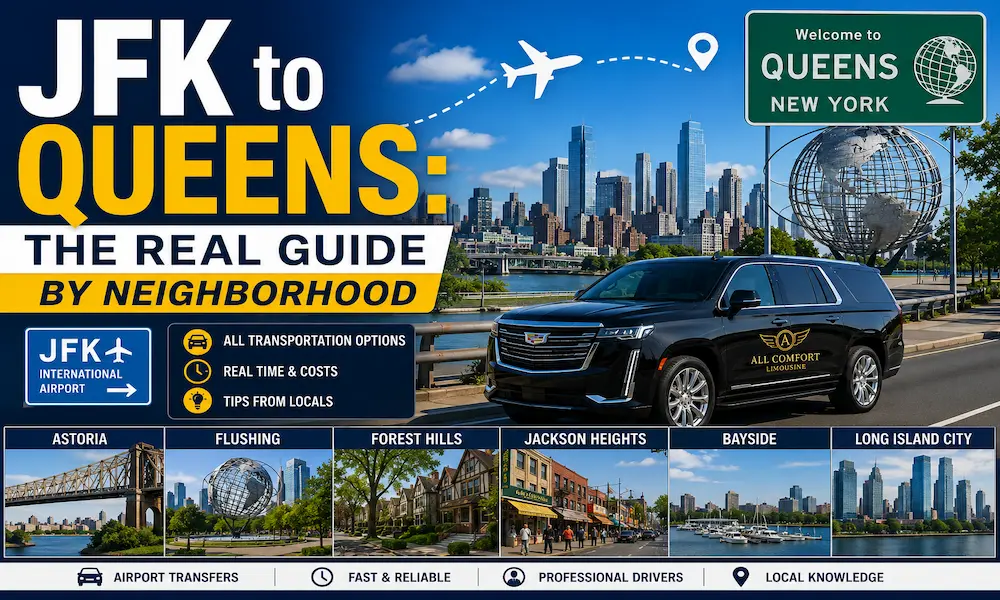
You land at JFK, grab your bag off the carousel, and realize something most guides never tell you: you’re already in Queens. The airport sits inside the borough. And yet getting to your actual address, whether that’s a walk-up in Astoria or a new build in Long Island City, can take anywhere from 10 minutes to over an hour depending on where exactly you’re headed and how you get there.
That’s the part nobody explains well. Most “JFK transportation” guides are written for Manhattan tourists. They talk about the $70 flat-rate taxi and the AirTrain to Penn Station, then treat Queens as an afterthought, a single line that says “also serves Queens.” But Queens isn’t one destination. It’s dozens of neighborhoods, each with its own distance, its own traffic pattern, and its own best route home.
This guide breaks it down properly, neighborhood by neighborhood, with real 2026 prices and honest travel times.
| QUICK ANSWER Closest neighborhoods (Jamaica, Howard Beach): 10-15 minutes by car, $25-35 by taxi. Mid-distance (Forest Hills, Rego Park, Flushing): 20-25 minutes, $35-45 by taxi. Farther out (Astoria, Long Island City, Bayside): 25-40 minutes depending on traffic, $40-55 by metered taxi. Most predictable for any distance: A pre-booked private car service with flat-rate pricing and flight tracking, so the fare doesn’t move even if traffic does. |
|---|
Why Queens Is Different from a Manhattan Trip
The $70 flat taxi fare everyone talks about only applies to Manhattan. The moment your destination is in Queens, Brooklyn, or the Bronx, the meter runs the whole way. That’s not a bad thing exactly, since Queens trips are usually shorter and end up cheaper than the Manhattan flat rate, but it does mean the price isn’t fixed unless you book a car service that quotes a flat rate up front.
It also means “how do I get to Queens” isn’t really one question. Someone flying into JFK to visit family in Jamaica has a completely different trip than someone heading to a hotel in Long Island City. Let’s go through every option, then get specific by neighborhood.
Price and Time Comparison
| Option | Typical Cost | Time (varies by neighborhood) | Best For |
|---|---|---|---|
| Subway (A, E, J, Z from AirTrain) | ~$11.75 | 20-70 min | Budget travelers near a subway line |
| AirTrain + LIRR | ~$12-17 | 15-40 min | Neighborhoods near an LIRR stop (Flushing, Woodside, Forest Hills) |
| Bus (Q6, Q10, Q3, etc.) | $2-7 | 15-45 min | Local Queens residents who know the routes |
| Metered Taxi | $25-55 | 10-40 min | Predictable, no app needed |
| Uber / Lyft | $20-70 | 10-40 min | Convenient, but surge-prone |
| Private Car Service | $45-90 flat | 10-40 min | Families, luggage, late arrivals, reliability |
Subway: A, E, J, and Z Trains
The AirTrain connects to two subway hubs: Howard Beach and Jamaica. From Howard Beach, the A train runs directly through Ozone Park, Woodhaven, and Richmond Hill before continuing toward Brooklyn. From Jamaica Station, the E, J, and Z trains fan out across central and western Queens, eventually reaching Jackson Heights, Elmhurst, and Long Island City on the E line.
This works well if your destination sits close to one of those lines. It works badly if it doesn’t. Astoria, for example, has no direct subway connection from JFK. You’d need to transfer at Jamaica or in Manhattan first, turning what should be a short trip into an hour-plus journey with a rolling suitcase and at least one flight of stairs. Before committing to the subway, check whether your neighborhood is actually on the A, E, J, or Z line, because a lot of Queens isn’t.
AirTrain Plus LIRR
If your destination is near an LIRR stop, this is the fastest transit option by a wide margin. Flushing, Woodside, Forest Hills, and Kew Gardens all have LIRR stations, and trains from Jamaica reach them in well under 20 minutes. Total cost runs $12 to $17 depending on peak or off-peak pricing, and the ride is far more comfortable than the subway if you’re carrying luggage, since LIRR cars have overhead racks and more room to sit.
The catch is frequency. LIRR trains to some of these stops run less often than the subway, especially at night, so check the schedule before you plan around it.
Local Buses
Queens has an extensive local bus network running directly out of the airport, and residents who know the system swear by it. The Q6 connects Jamaica Station to the JFK terminals. The Q10 runs to Kew Gardens and Forest Hills. The Q3 heads toward Jamaica and beyond. Fares run $2.90 with an OMNY tap, making this the cheapest option on this list by far.
The tradeoff is time and predictability. Buses sit in the same traffic as everyone else, stop frequently, and aren’t the move if you’ve got heavy bags or a tight schedule. Good for locals who travel light and know exactly which bus to catch. Not ideal for a first-time visitor juggling suitcases.
Metered Taxi
Yellow and green taxis both serve Queens, and because there’s no flat rate outside Manhattan, the meter runs based on distance and time. As a rough guide, expect $25 to $35 for close neighborhoods like Jamaica or Howard Beach, $35 to $45 for mid-distance spots like Forest Hills or Flushing, and $40 to $55 for farther destinations like Astoria or Long Island City, before tolls and tip.
Green cabs (officially “Boro Taxis”) were created specifically to serve trips like these, outer-borough pickups that yellow cabs used to avoid. You’ll find them queued at the taxi stand alongside yellow cabs. Either works the same way: get in line at the official stand, tell the driver your address, and the meter does the rest. As always, never accept a ride from someone approaching you inside the terminal. That’s an unlicensed operator, and you have no recourse if something goes wrong.
Uber and Lyft
Rideshares work reasonably well for Queens trips since most destinations are closer than a Manhattan run, which keeps base fares lower. A ride to Jamaica or Ozone Park might run $20 to $30 on a quiet afternoon. The problem, as always, is surge pricing. Friday and Sunday evenings, holidays, and bad weather can push that same ride to $60 or more, and JFK’s pickup zone can mean a 10 to 20 minute wait before your driver even arrives, sometimes longer during a surge event when drivers are slower to accept.
Private Car Service: The Predictable Option
Here’s the thing about Queens trips specifically: because the distances are shorter than a Manhattan run, a flat-rate car service often ends up costing close to what a metered taxi or a surging Uber would anyway, minus the uncertainty.
With All Comfort Limousine’s JFK car service, you get a quoted flat rate before you land, so the price doesn’t change if the Van Wyck is backed up or if your flight gets in late. A chauffeur tracks your flight and adjusts the pickup automatically, which matters more than people expect when you’re flying internationally and customs takes an extra hour. With Meet and Greet, your driver is waiting inside at baggage claim holding a sign with your name, not idling curbside while you try to figure out which door leads outside.
For Queens specifically, this matters for a few reasons that don’t come up as often in a Manhattan conversation. A lot of Queens households are multi-generational, meaning you might be picking up parents, grandparents, and kids all in one trip. An SUV or Sprinter van handles that without splitting into two or three separate cars. Car seats are available on request for families flying home with young children, something taxis legally can’t provide and rideshare drivers rarely carry. And the 60-minute free wait time built into the booking means a late flight doesn’t turn into a scramble.
| Flying into JFK and heading home to Queens? All Comfort Limousine offers flat-rate transfers to every Queens neighborhood, with flight tracking and Meet and Greet included. Book your ride now |
|---|
Traffic and Timing: What Actually Slows You Down
The Van Wyck Expressway is the road most trips out of JFK start on, and it’s one of the more congested stretches in the city during peak hours. If your destination is west toward Long Island City or Astoria, you’ll likely pick up the Grand Central Parkway after the Van Wyck, which has its own rush-hour slowdowns, particularly near LaGuardia. Trips toward Flushing and northeastern Queens tend to move faster since they avoid the worst of both roads.
Friday afternoons from 3 to 7 PM and Sunday evenings from 4 to 8 PM are consistently the roughest windows. Midday on weekdays, roughly 10 AM to 2 PM, is the sweet spot for anyone with flexibility. A chauffeur who drives these roads daily knows when to stay on the highway and when local streets actually move faster, which is exactly the kind of judgment call an app-based driver unfamiliar with the area won’t make.
JFK to Queens by Neighborhood
This is the part most guides skip, and it’s the part that actually matters.
Jamaica and Howard Beach. These are the closest neighborhoods to the airport, and it shows. Expect 10 to 15 minutes by car and a taxi fare in the $25 to $35 range. Both also have direct AirTrain access to transit, making them the easiest spots in Queens to reach by any method.
Ozone Park, Woodhaven, and Richmond Hill. Just a short drive further out, these neighborhoods run 12 to 18 minutes by car with fares typically landing between $25 and $35. The A train from Howard Beach serves this corridor directly, so subway is a genuinely solid option here too.
Forest Hills, Rego Park, and Kew Gardens. Around 18 to 25 minutes by car depending on traffic, with taxi fares generally $30 to $45. Forest Hills and Kew Gardens both have LIRR access, so the AirTrain-to-LIRR route is worth considering if you’re arriving during daytime service hours.
Flushing. Roughly 20 to 25 minutes by car, with fares in a similar $35 to $45 range. Flushing has its own LIRR station, making it one of the better-connected neighborhoods for transit if you don’t want to drive.
Jackson Heights, Elmhurst, and Corona. Expect 20 to 30 minutes and fares between $35 and $45. The E train from Jamaica reaches this corridor, though the ride involves a longer transit time than the closer neighborhoods.
Bayside, Whitestone, and Fresh Meadows. These sit further northeast, generally 20 to 30 minutes by car with comparable pricing to Flushing. Public transit options thin out here, since none of these neighborhoods sit directly on a subway or LIRR line, which makes car service or taxi the more practical choice for most travelers.
Long Island City and Astoria. The farthest major neighborhoods from JFK within Queens, typically 25 to 40 minutes depending on the hour, with metered taxi fares running $40 to $55. Neither neighborhood has a direct subway connection from the airport, which is exactly why a lot of Astoria and LIC residents skip the transit puzzle entirely and book a car in advance.
The Rockaways. A separate case geographically, closer to JFK by distance but often slower by transit due to the A train’s longer run down the peninsula. Driving is typically 15 to 25 minutes depending on which part of the Rockaways you’re headed to.
Which Option Actually Makes Sense for You
If you live in Jamaica or Howard Beach and you’re traveling light, a taxi or even a short bus ride home is perfectly reasonable. The distance is short enough that almost any option gets you home quickly.
If you’re headed to Flushing, Forest Hills, or another LIRR-connected neighborhood and you’re arriving during daytime service hours, the AirTrain-to-LIRR combination is genuinely one of the better transit options in the entire city. Fast, comfortable, and cheap relative to a car.
If your destination is Astoria, Long Island City, or another neighborhood without a direct transit line, weigh your options carefully. The subway route will likely involve a transfer and a longer total trip than the distance suggests. A flat-rate car service removes that guesswork entirely and, given how short these trips are compared to a full Manhattan run, often costs less than people assume.
Families with kids, groups with a lot of luggage, or anyone landing late at night should lean toward a pre-booked car regardless of neighborhood. Late-night rideshare availability drops across the board, taxis can’t legally provide car seats, and dragging bags through a subway transfer at 11 PM is nobody’s idea of a good landing.
| Need a ride from JFK to anywhere in Queens? Flat rates, flight tracking, and a driver who actually knows the Van Wyck at rush hour. Reserve your JFK to Queens transfer |
|---|
Frequently Asked Questions
How much does a taxi from JFK to Queens cost?
It depends on the neighborhood, since Queens trips run on the meter rather than a flat fare. Close neighborhoods like Jamaica or Howard Beach typically run $25 to $35. Mid-distance spots like Flushing or Forest Hills run $35 to $45. Farther neighborhoods like Astoria or Long Island City run $40 to $55, before tolls and tip.
Is there a subway from JFK to Queens?
Yes, but only to neighborhoods along the A, E, J, or Z lines. The AirTrain connects to Howard Beach (A train) and Jamaica Station (E, J, Z trains), covering areas like Ozone Park, Richmond Hill, Jackson Heights, and Elmhurst. Neighborhoods like Astoria and much of northeastern Queens don’t have a direct connection.
How long does it take to get from JFK to Astoria?
By car, expect 25 to 40 minutes depending on traffic on the Van Wyck and Grand Central Parkway. There’s no direct subway line, so transit options typically take longer and involve a transfer.
What’s the fastest way from JFK to Flushing?
The AirTrain to Jamaica Station, then LIRR to Flushing, is usually the fastest option during daytime hours, often under 25 minutes total. By car during light traffic, the drive itself runs about 20 minutes.
Do car services charge a flat rate to Queens?
Metered taxis and rideshares charge based on distance and traffic for Queens trips, since the flat rate only applies to Manhattan. Pre-booked private car services like All Comfort Limousine quote a flat rate for Queens destinations in advance, so the price is confirmed before you land.
Is it cheaper to take public transit from JFK to Queens than a car?
Usually yes on paper, especially for neighborhoods directly on a subway or LIRR line. The gap narrows for shorter trips like Jamaica or Howard Beach, where the time and hassle saved by a car can outweigh a modest price difference, particularly with luggage.
Do I need to tip my JFK car service driver?
A standard tip for airport car service is 15 to 20% of the fare, similar to a restaurant tip. For more detail on airport tipping norms, see our full guide on tipping airport drivers.
Can I book a car seat for a JFK to Queens ride with kids?
Yes. All Comfort Limousine provides car seats on request when booked in advance, something most taxis and rideshare vehicles can’t legally offer for children under 8 in New York State.
The Bottom Line
Queens isn’t a single answer, and treating it like one is how people end up standing at a bus stop in the rain or paying double what a trip should cost. Jamaica and Howard Beach residents have it easy no matter what they choose. Flushing and Forest Hills travelers should seriously consider the LIRR. And anyone headed to Astoria, Long Island City, or the neighborhoods without a direct train line is usually better off skipping the transfer puzzle altogether.
Whichever neighborhood you’re headed to, a pre-booked car service takes the guessing out of it. Flat rate, flight tracking, someone waiting for you at baggage claim, and a driver who already knows whether the Van Wyck or the local streets are moving faster today.
| All Comfort Limousine — JFK to Queens, Done Right Flat-rate pricing to every Queens neighborhood. Flight tracking, Meet and Greet, car seats on request, 24/7 availability. Book your ride |
|---|