
Brooklyn Cruise Terminal Parking: Complete Guide to Rates, Location, and Smarter Alternatives
July 2, 2026
Renting a Car in the Hamptons: What You Actually Need to Know Before You Book
July 5, 2026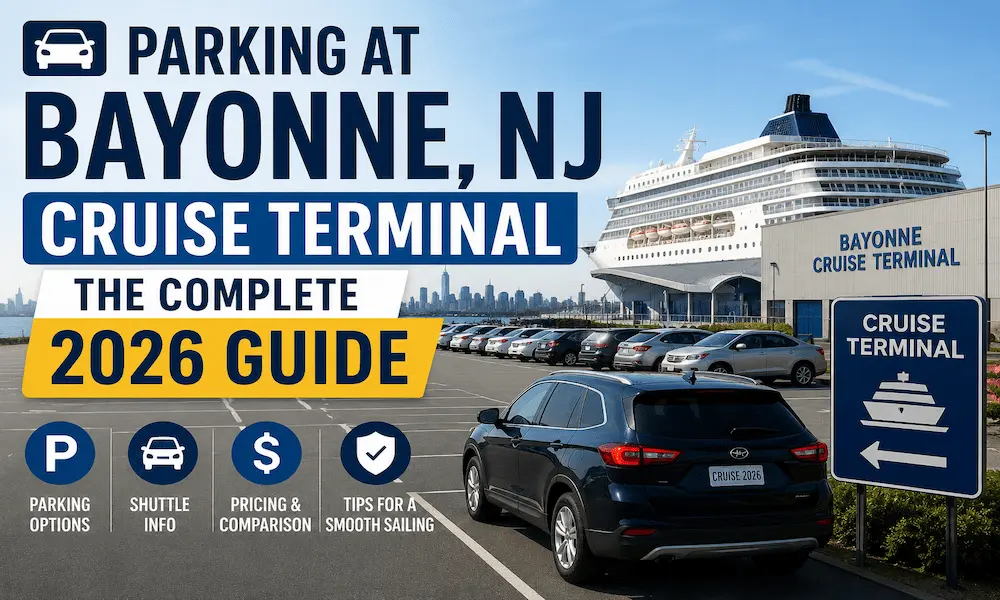
If you’re sailing out of Cape Liberty this year, chances are you’ve already typed some version of “parking at Bayonne NJ cruise terminal” into Google more than once. Once while you were booking the cruise, and probably again a few nights before departure when the actual logistics started sinking in. That’s a normal reaction. Cape Liberty isn’t an airport with five different garages and a color-coded map. It’s one terminal, one main garage, and a set of overflow lots that only kick in when the main garage fills up, and getting any of those details wrong on a Saturday morning sailing day can turn into a genuinely stressful start to a vacation.
Here’s the short version before we go deep: the official Cape Liberty parking facility sits directly next to the terminal at 14 Port Terminal Boulevard in Bayonne, NJ 07002, no reservation is required, and standard vehicles are currently running somewhere between $30 and $35 per day depending on the season and which source you check. That’s the headline number. What most guides skip is the part that actually matters once you’re standing in that garage at 6:45 in the morning: how the overflow system works, why your credit card is the only thing that’ll get you through the gate, what a week of parking actually costs versus a private car service, and how families and groups should think about this differently than a solo traveler with one carry-on.
We’re covering all of it below, including the parts the port’s own FAQ page glosses over.
Where Cape Liberty Cruise Port Parking Actually Is
Cape Liberty Cruise Port sits on a peninsula in Bayonne, New Jersey, directly across the harbor from Staten Island and about eight miles southwest of Lower Manhattan. The official address most cruise lines and mapping apps use is 14 Port Terminal Boulevard, Bayonne, NJ 07002, though you’ll sometimes see 4 Port Terminal Blvd referenced too. Both point you to the same peninsula, formerly the Military Ocean Terminal, now home to Royal Caribbean and Celebrity Cruises sailings to Bermuda, the Bahamas, the Caribbean, and New England and Canada.
The parking garage itself is built right into the terminal complex, close enough that most passengers describe it as a two to three minute walk from car to check-in counter. That’s genuinely one of the more convenient setups among East Coast cruise ports, and it’s a big part of why so many New York and New Jersey cruisers choose Cape Liberty over sailing out of Manhattan.
How the Garage and Overflow System Works
The main garage is roughly 750 feet from the terminal entrance, which is close enough to walk your luggage over without much trouble. On busier sailing days, especially when two ships are in port or during peak summer and holiday weekends, that garage fills up and the port shifts arriving cars into overflow lots a short distance away. If you get directed to an overflow lot, don’t worry, there’s a free shuttle running continuously between those lots and the terminal, and it typically takes about three minutes.
A few practical details that matter more than they sound:
No reservations, but not exactly first-come-first-served either. You can’t book a spot ahead of time the way you would at an airport garage. You show up, you park wherever the attendant directs you, and you pay through the automated system. The port has also moved toward an app-based sign-up through Metropolis, which lets you register your license plate ahead of time so you’re not fumbling with a ticket machine on departure morning. It’s optional, but if you’ve got five minutes before your trip, it’s worth setting up.
Cash isn’t accepted. This trips up more people than you’d expect. Bring a Visa, Mastercard, American Express, or Discover, because the automated garage system doesn’t take cash at all.
Height restrictions exist. The garage has a 7’4″ clearance limit. If your vehicle is taller than that, you’ll be directed straight to the open-air overflow lot instead, which has no such restriction.
Oversized vehicles cost more. RVs and minibuses run roughly double the standard rate, and full-size buses are charged significantly more on top of that. If you’re driving anything larger than a standard SUV, budget accordingly.
ADA parking is included at the standard rate. Handicap parking spaces are available in the main garage at no additional cost beyond the normal daily fee.
What Parking at Bayonne NJ Cruise Terminal Actually Costs
This is where a lot of the answers online contradict each other, mostly because rates get adjusted periodically and older articles don’t get updated. As of 2026, the most consistent figure across current sources puts standard self-parking at roughly $30 to $35 per day for a car or SUV, with RVs and minibuses around double that, and full-size buses higher still. Some listings show weekly rates in the $110 to $180 range for a full seven-day stretch, which works out to a modest per-day discount compared to paying the daily rate every single day.
The number that actually matters, though, is the total. A five-night cruise at roughly $32 a day puts you at around $160 just for parking, before gas, tolls, and the toll booths you’ll hit on the Turnpike getting there and back. A seven-night cruise pushes that closer to $220 or more. None of that includes the wear and tear of navigating Route 440 and the Bayonne Bridge approach twice, once tired and excited before the cruise, and once again jet-lagged and worn out after it.
Off-site lots near the port, run by companies like Rightway Parking or Park & Sail NJ, advertise lower daily rates, sometimes as low as $9 to $17 per day, usually with a free shuttle included. The tradeoff is that you’re parking further from the terminal and relying on a third-party shuttle schedule rather than walking straight from your car. For a short weekend cruise, that tradeoff is often worth it. For anyone juggling luggage, kids, or older parents, the extra shuttle step adds friction at exactly the moment you don’t want it.
Directions to Cape Liberty Cruise Port
However you’re arriving, almost every route funnels through the same exit: Exit 14A off the New Jersey Turnpike/I-95.
From New York City (Lincoln or Holland Tunnel): Take either tunnel into New Jersey, follow I-495 West or the connecting roads to the NJ Turnpike South, then take Exit 14A. From there, follow signs for Route 440 South, continue about a mile and a half, and make a left into the Bayonne terminal complex. The cruise terminal itself is about two miles straight ahead once you’re inside the gate.
From Staten Island: Take the Verrazzano-Narrows Bridge into Staten Island, then I-278 West to Route 440 North over the Bayonne Bridge. Continue on Route 440 North roughly three miles and make a right into the terminal complex.
From the George Washington Bridge or points north: Cross the GWB, follow signs for the NJ Turnpike/I-95 South, and take Exit 14A. Follow the directions above from there.
From Newark Liberty International Airport: This is genuinely the shortest connection of any nearby airport, roughly ten miles and fifteen to twenty minutes by road under normal traffic, which makes Newark far more convenient for this port than JFK or LaGuardia. If you’re flying in specifically to catch a cruise, our guide on getting from Newark Airport to NYC covers the same corridor and the tradeoffs between rideshare, taxi, and a scheduled car.
Nearly every route funnels through Exit 14A and the same stretch of Route 440, which is fine on an ordinary Tuesday and considerably less fine on a Saturday morning when three or four thousand other passengers are trying to make the same turn within the same two-hour window.
Getting There Without Driving Yourself
If you’re not driving, taxi service is available from three Bayonne-based cab companies, and the port is roughly three miles from the closest point on the Hudson-Bergen Light Rail line. Passengers coming from Manhattan can take the PATH train to Jersey City or Hoboken, transfer to the Light Rail toward Bayonne, and get off at the 34th Street Station, which puts you directly across Route 440 from the terminal complex, still a taxi ride away from the gate itself.
Bus service exists too. The 119 and 99S buses run along Kennedy Boulevard into Bayonne, and from the closest stop near 33rd Street you’d still need a cab for the final stretch. None of these options are impossible, but combine an early morning, a train transfer, a bus, and rolling luggage, and it becomes obvious why so many passengers weigh public transit against a scheduled car and quietly choose the car.
The Real Math: Parking vs. a Private Car Service
Most parking guides stop at listing rates. Let’s actually run the comparison, because this is usually the deciding factor for anyone driving in from outside Bayonne itself.
Take that same five-night cruise. On-site parking at roughly $32 a day runs about $160, plus gas, tolls, and the round-trip wear on your own car. Compare that to a one-way private car service from your home in New Jersey, Long Island, Connecticut, or anywhere in the five boroughs, with a second trip booked for your return. Depending on distance and vehicle size, a round-trip car service frequently lands in a comparable range to five or six nights of parking, and for a full week-long cruise, it often comes out ahead, especially once you split the cost across two or three passengers traveling together.
It’s the same pattern we’ve seen play out at the airport. Our breakdown of what it actually costs to park at JFK Airport shows nearly identical math: multi-day parking adds up fast, and a scheduled ride frequently wins once you account for the whole trip rather than just comparing daily rates in isolation.
If you want to run your own numbers before deciding, our pages on how much a limousine costs per hour and chauffeur hire pricing break down current rates so you can compare them directly against whatever your expected parking total comes out to.
Timing Your Arrival
Cape Liberty sailings typically have passengers begin arriving mid-morning, with boarding windows assigned by the cruise line to spread out the crowd. Because the garage fills fastest in the first hour or two after it opens, arriving right at the earliest allowed time on a busy sailing weekend often means more time circling for a spot, not less. If your assigned arrival window has any flexibility, aiming for the middle of it rather than the very start usually means an easier walk in and a shorter wait at the check-in counter.
Traveling With Family or a Larger Group
Parking logistics change quickly once you’re not traveling solo. Unloading luggage for four or five people in a garage, then walking everyone across the terminal plaza to check-in, takes a lot longer than it looks on paper, and it’s a very different experience with young kids in tow than it is with adults who can carry their own bags. If car seats are part of your plan for getting to the port, our page on car seats and limo service in NYC and NJ covers what’s required and what a private ride can accommodate.
For bigger groups, it’s worth checking exactly how many people your vehicle option seats before booking anything. Our guide on how many people a limo actually seats is a useful reference if you’re trying to fit an extended family into one vehicle instead of splitting into two cars and doubling your own parking bill in the process.
What Nobody Mentions About the Actual Experience
A handful of smaller details that matter on departure day but rarely make it into official guides: keep your parking ticket and cruise documents together at all times, since you’ll need that stub to retrieve your car after the cruise, and losing it turns a routine pickup into a genuinely frustrating conversation with the attendant. If you’re tipping a porter or a driver who helps with your bags, it’s worth knowing the norms ahead of time rather than guessing in the moment. Our guide on how much to tip a driver to the airport applies just as well to cruise terminal drop-offs.
And the return trip deserves more thought than most people give it. You disembark tired, possibly jet-lagged, dealing with customs and a garage full of other passengers all retrieving cars at once. Driving yourself home in that state isn’t dangerous exactly, but it’s not the relaxing end to a vacation most people picture either.
If You’re Comparing New York Cruise Terminals
Cape Liberty isn’t the only option for New York-area sailings. Some cruise lines depart from the Manhattan Cruise Terminal or the Brooklyn Cruise Terminal in Red Hook instead, and each has a completely different parking and access setup. If you’re weighing terminals or booking transportation for a group sailing from a different pier, our guides on car service to the Manhattan Cruise Terminal and parking at the Brooklyn Cruise Terminal cover the same ground for those piers.
A Simpler Way to Handle Departure Day
Here’s the honest takeaway after all of this: parking on-site at Cape Liberty works perfectly well for a short cruise if you don’t mind the Route 440 traffic and the small chance of getting shuffled to an overflow lot. For a longer cruise, or for anyone coming from outside Bayonne itself, both the math and the fatigue factor start pointing toward a scheduled car service instead.
At All Comfort Limo, this is one of the trips we handle constantly. A driver picks you up from your home, your hotel, or Newark, JFK, or LaGuardia airport, handles the Turnpike and Route 440 traffic without you having to think about Exit 14A, and drops you right at the terminal entrance with your luggage taken care of. When you’re back, we’re there waiting again, so the cruise ends the same way it started, without a search for a parking ticket or a tired drive home through Bayonne traffic. You can browse current vehicles on our fleet page, or go ahead and book your ride directly for your sailing date.
Frequently Asked Questions
How much does parking cost at the Bayonne NJ cruise terminal?
Standard vehicles currently run roughly $30 to $35 per day, with RVs and minibuses charged around double that and full-size buses higher still. Weekly rates offer a modest discount over paying daily. Always confirm current pricing before you travel, since port rates are adjusted periodically.
Do I need a reservation to park at Cape Liberty?
No. The official garage doesn’t take advance reservations. You show up on sailing day and park wherever the attendant directs you, though you can pre-register your license plate through the Metropolis app to speed up entry.
Is cash accepted at the parking garage?
No. The automated system only accepts major credit cards, so bring a Visa, Mastercard, American Express, or Discover.
How far is the parking garage from the terminal?
The main garage is about 750 feet from the terminal entrance, roughly a two to three minute walk. If you’re directed to an overflow lot, a free shuttle runs continuously and typically takes about three minutes.
What happens if the main garage is full?
You’ll be directed to one of the overflow lots nearby. These are served by a free, continuous shuttle to and from the terminal, so you’re never stuck walking a long distance with luggage.
Is there a height restriction for the garage?
Yes, the main garage has a 7’4″ clearance limit. Taller vehicles are directed straight to the open-air overflow lot, which has no height restriction.
What’s the closest airport to Cape Liberty Cruise Port?
Newark Liberty International Airport, roughly ten miles and fifteen to twenty minutes by road, making it significantly more convenient than JFK or LaGuardia for this particular port.
Is it cheaper to book a car service than to park for a week-long cruise?
Often, yes, once you account for gas, tolls, and the wear of two round trips through Bayonne traffic. A round-trip private car service frequently lands in a similar or lower range than a full week of on-site parking, especially when the cost is split across a group.