
Celebrating 250 Years of Freedom: Your Complete Guide to America’s 2026 Semiquincentennial
June 9, 2026
Car Service NYC to JFK Airport: Everything You Need to Know Before You Book (2026)
June 13, 2026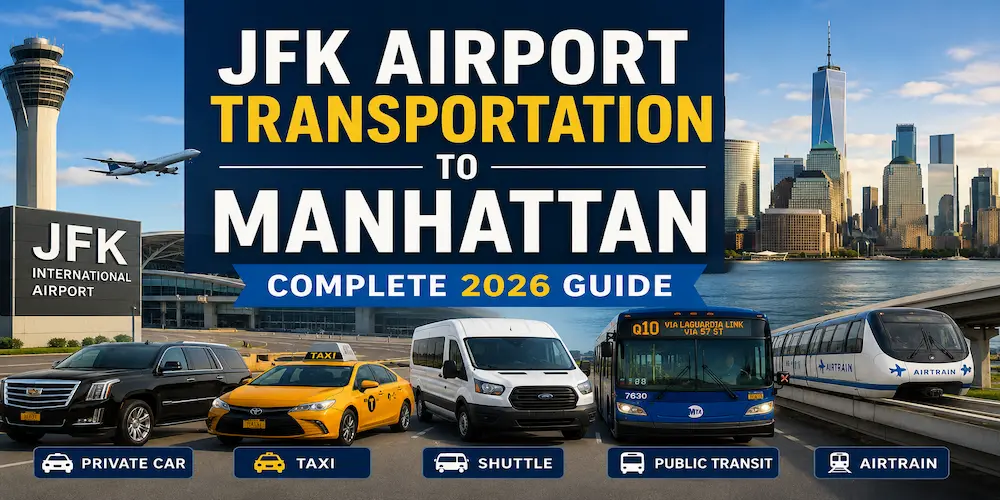
Getting from JFK Airport to Manhattan sounds simple until you are standing at baggage claim, jet-lagged, with two suitcases, and suddenly every option feels equally confusing. The airport is about 15 to 16 miles from Midtown, but that distance tells you almost nothing about how long your trip will actually take or what it will cost you.
The honest answer is that the right transportation choice depends entirely on who you are, what time you are arriving, how much luggage you have, and what your budget looks like. This guide walks through every realistic option with actual 2026 numbers, honest trade-offs, and the specific situations where each one makes the most sense.
There is one thing worth knowing upfront: JFK is currently going through the biggest physical transformation in its history. New terminals are opening, road access points are shifting, and pickup zones have changed at multiple terminals this year. Whatever option you pick, confirm your terminal assignment in your airline app within 24 hours of your flight. Terminal assignments are moving around more than usual in 2026 as construction phases progress.
Option 1: AirTrain to the Subway
The bottom line: Cheapest option, slowest ride, best for solo travelers with light bags
The AirTrain is the elevated rail that connects every JFK terminal to two subway and commuter rail hubs. Within the airport itself, it runs as a free loop. You only pay when you exit at Jamaica Station (Queens subway hub) or Howard Beach Station (A train connection).
As of 2026, the AirTrain single-ride fare is $8.75, payable by tapping any contactless debit or credit card, smartphone, or OMNY card at the exit turnstiles. The old MetroCard system was phased out at the end of 2025, so OMNY contactless is now the standard. Children under five ride free.
Once through the turnstile at Jamaica, you can board the E, J, or Z subway lines into Manhattan. From Howard Beach, the A train takes you to lower and upper Manhattan. The subway fare adds another $2.90 per ride with OMNY, or $3.25 for a single-use ticket.
Total cost: roughly $11.65 to $12 depending on how you pay.
Total travel time: expect 60 to 90 minutes to most Manhattan destinations, sometimes longer if you are heading to upper Manhattan from Howard Beach or dealing with weekend service changes.
Where this works well: a solo traveler arriving mid-morning on a weekday with a backpack and a carry-on, heading to a hotel near a subway stop. Where it stops working well: two suitcases, children, late night arrivals, or destinations far from a subway station.
One important note for 2026 specifically: the AirTrain is experiencing temporary service modifications at several central terminal area stations due to construction. Allow extra buffer time and check for service alerts at jfkairport.com before you leave.
Option 2: AirTrain to the Long Island Rail Road
The bottom line: Fastest public transit option, significantly underrated
This route starts exactly the same as the subway option. You take the free AirTrain to Jamaica Station. But instead of going down to the subway platform, you walk up to the LIRR level and board a commuter train heading to Penn Station or Grand Central Madison in Midtown Manhattan.
The LIRR leg takes about 20 minutes. Add the AirTrain and the walk between platforms, and you are typically at Penn Station or Grand Central in 35 to 50 minutes from your terminal. That is genuinely faster than driving during peak hours.
Cost breakdown for 2026: the AirTrain is $8.75, and the LIRR ticket from Jamaica to Penn Station runs $5.25 off-peak or $7.25 during peak hours. Total comes to roughly $14 to $16 depending on your timing.
Why this option deserves more attention than it gets: most travel guides either skip it or mention it briefly as a footnote. But for anyone landing at JFK and heading to Midtown, this combination beats every other option on the speed-to-cost ratio. You get a seat, a direct ride, and arrival in the heart of the city in under an hour for under $20.
The trade-off: it drops you at Penn Station or Grand Central, which is ideal if your destination is nearby. If your hotel is on the Lower East Side or in Greenwich Village, you will still need a short taxi or subway ride from the train station.
Practical tip: board toward the front of any eastbound LIRR train you take in Manhattan. That position puts you closer to the AirTrain connector when you arrive at Jamaica on the way back.
Option 3: Yellow Taxi
The bottom line: Predictable cost, door-to-door service, genuinely useful for groups
Yellow taxis at JFK operate on a flat rate set by the New York City Taxi and Limousine Commission. That flat base fare is $70 for any trip between JFK and any Manhattan address, in either direction, regardless of traffic or time of day.
Here is where it gets important: $70 is the starting number, not what you will pay. Add tolls (typically $6 to $12 depending on your route through Queens), the $2.50 congestion surcharge for trips entering Manhattan, various smaller state surcharges, a $5 weekday rush-hour fee between 4 PM and 8 PM, and a standard 15 to 20 percent tip. The realistic all-in cost for most JFK to Manhattan taxi trips in 2026 lands between $90 and $120.
That number surprises a lot of first-time visitors. The flat rate is real, but the add-ons are also real, and they are not optional.
Travel time: 30 to 75 minutes depending heavily on when you are traveling and which route your driver takes. The Van Wyck Expressway, the main road from JFK into Queens, can crawl during morning and evening rush hours.
The taxi’s biggest advantage over rideshare apps: zero surge pricing. A rainstorm, a sold-out concert at Madison Square Garden, a major event in Midtown — none of these things can push your taxi fare higher. The regulated flat rate holds.
Where taxis genuinely shine: a group of three or four splitting the fare. At roughly $25 to $30 per person all-in, a shared taxi to a central Manhattan address often beats the AirTrain and subway on both cost and convenience once you account for multiple people.
Where to find the taxi queue: every JFK terminal has a designated taxi stand outside arrivals. Follow the signs. Do not accept rides from anyone approaching you inside the terminal offering transportation — official yellow cabs queue at designated stands only.
Option 4: Uber, Lyft, and Rideshare Apps
The bottom line: Convenient when pricing is reasonable, unreliable when it isn’t
Rideshare apps work at JFK. Every terminal has a designated for-hire vehicle pickup zone, though the locations of those zones have shifted at several terminals due to the ongoing construction. Always check the app for the current pin location rather than walking to wherever you remember the pickup area being on a previous trip.
The core issue with rideshare from JFK is price unpredictability. Under normal conditions, an UberX or Lyft to Midtown Manhattan runs somewhere in the $60 to $90 range before tip. During rain, during a busy Friday evening, or during any surge event, the same ride can easily reach $140 to $200 or more.
That price variance is a real problem when you are choosing transportation options at the airport. The yellow taxi’s $90 to $120 all-in starts looking reasonable when a rideshare is quoting $160 during a thunderstorm.
Where rideshare works well: off-peak arrivals, when the app shows a reasonable fare, and you are traveling alone or with one other person to a destination that isn’t easily reached by the LIRR. Shared rideshare pools (UberPool/Lyft Share) also exist and can lower costs, though pickup wait times and additional stops make them unpredictable.
Where rideshare creates frustration: peak hours, bad weather, major events in the city, and situations where the terminal pickup zone is confusing due to construction.
Option 5: Pre-Booked Private Car Service
The bottom line: The most reliable option for business travelers, families, and late-night arrivals
A professional car service is fundamentally different from a rideshare in ways that matter a lot when you are tired, carrying luggage, and just want to get somewhere efficiently.
The key differences: the price is confirmed before you land. There is no surge pricing, no fare estimate that changes by the time you tap confirm. A professional chauffeur tracks your flight in real time, so if your flight is delayed by 90 minutes, the driver adjusts automatically and is at the right terminal at the right time. For families or business travelers, this kind of reliability is worth paying for.
The standard setup for a quality airport car service includes curbside or inside-terminal pickup (meet and greet service), luggage assistance, and a clean, tracked vehicle. If you want a driver holding a sign with your name at baggage claim rather than a curbside scramble, that is what a proper airport meet and greet service provides.
Typical 2026 pricing for a private sedan from JFK to Manhattan: $80 to $130 depending on the provider, vehicle type, and any additional services. SUVs and larger vehicles run higher. These rates are all-in quotes at the time of booking, which is the point — you know the number before you travel.
For corporate travelers, many professional car services offer account-based booking and invoicing, making it easy to track travel expenses. If your company handles frequent executive travel, a dedicated corporate travel arrangement through a professional car service eliminates the reimbursement headache of individual rideshare trips.
When private car service makes the most sense:
Late-night arrivals when the idea of the subway at 1 AM with luggage is unappealing. Families with young children, strollers, and car seat needs. Business travelers who want to work or make calls during the ride without distraction. Groups of four or more where a large SUV or van provides both the space and the economics. International travelers arriving at JFK for the first time who do not want to figure out the subway system while jet-lagged.
Book at minimum 24 hours in advance. During summer weekends, holidays, and peak travel periods, quality providers fill up.
Option 6: Shared Shuttle Van
The bottom line: A middle ground that makes sense mainly for solo travelers
Shared shuttles pick up multiple passengers at JFK and drop them at different Manhattan addresses. The van fills up, then runs a route through the city making several stops before reaching yours.
Cost: roughly $30 to $35 per person in 2026 depending on the operator and destination zone.
Travel time: longer than any other ground option due to the multiple stops, often 75 to 100 minutes or more depending on how many passengers are aboard and where everyone is going.
The honest trade-off: for a solo traveler, this option costs more than the AirTrain and LIRR but less than a taxi, and delivers door-to-door service. That is a reasonable position in the middle. For two or more travelers, the math typically favors just taking a taxi or car service, since the total shuttle cost approaches taxi pricing while the taxi delivers a more direct, faster route.
JFK to Manhattan: Full Comparison Table
| Transportation | 2026 Cost (All-In) | Typical Travel Time | Best Suited For |
|---|---|---|---|
| AirTrain + Subway | $12 per person | 60–90 minutes | Solo, light luggage, budget |
| AirTrain + LIRR | $14–16 per person | 35–50 minutes | Speed and value, Midtown-bound |
| Yellow Taxi | $90–120 total | 30–75 minutes | Groups 2–4, all luggage types |
| Rideshare (Uber/Lyft) | $60–160+ variable | 30–75 minutes | Off-peak, flexible budget |
| Private Car Service | $80–130 fixed | 30–60 minutes | Business, families, reliability |
| Shared Shuttle | $30–35 per person | 75–100 minutes | Solo, door-to-door on a budget |
How to Choose Based on Your Actual Situation
Rather than a vague “it depends,” here is a direct breakdown by traveler type.
Solo traveler, carry-on only, daytime arrival, Midtown destination: AirTrain to the LIRR. Fast, cheap, comfortable. You will be at Penn Station or Grand Central in under an hour for about $16.
Solo or couple, checked bags, Midtown destination, flexible on time: Still the LIRR, but factor in a few extra minutes for handling bags at the platform. Alternatively, a taxi if the two of you split it cleanly.
Family of four with three suitcases: Yellow taxi or private car service. The subway is technically doable but practically unpleasant with children and bags. Split four ways, the taxi costs about the same per person as the LIRR with infinitely less logistical hassle.
Business traveler on an expense account: Pre-booked car service with meet and greet. Fixed price, professional driver, no app chaos after a long flight.
Arriving after midnight: Pre-booked car service is the most comfortable call. Trains run less frequently at that hour, and having a driver confirmed and waiting before you land removes a lot of stress from a late arrival.
Arriving during peak traffic, 5 to 7 PM: The LIRR beats everything. It runs on its own schedule regardless of what the Van Wyck Expressway looks like. A taxi or rideshare during this window can take 90 minutes or more.
Very tight budget, any time: AirTrain to the subway. $12 all-in is the floor for getting from JFK to Manhattan, and it works perfectly well if you have manageable luggage and a destination near a subway line.
The 2026 Construction Factor: What It Actually Means for Your Ride
Most transportation guides for JFK skip this entirely. In 2026, that is a meaningful omission.
JFK is in the middle of a $19 billion rebuilding project. New Terminal 1 (the New Terminal One) is opening its first 14 gates in mid-2026, replacing the old terminals on the south side of the airport. New Terminal 6 is opening on the north side with 10 new gates. As a result, more than 50 airlines are shifting terminals this year.
For ground transportation, this creates a few specific problems. Pickup and drop-off zones have changed at several terminals and may change again as new phases open. Road access to certain areas of the airport involves detours and lane reductions that add time for unfamiliar drivers. The AirTrain inner loop is also undergoing service modifications at central terminal stations this year.
Three practical steps to protect your ground transportation plan in 2026:
First, verify your terminal in your airline app or email within 24 hours of travel. Do not assume it matches what your ticket said three weeks ago.
Second, if you pre-booked a car service, send them your confirmed terminal so they can stage at the correct pickup zone. Quality providers track this themselves, but confirming removes any ambiguity.
Third, check jfkairport.com for the latest travel advisories before leaving for the airport, especially if you have an early morning departure or late-night arrival, when construction-related overnight lane work is most active.
Frequently Asked Questions
Is there a direct subway from JFK to Manhattan? No subway line runs directly from JFK. The first leg always involves the free AirTrain within the airport to either Jamaica Station or Howard Beach Station, where you then connect to subway or commuter rail service.
Does the AirTrain run 24 hours? Yes, the AirTrain runs around the clock. The subway also runs 24 hours, though frequency drops overnight. The LIRR has overnight gaps in service, so if you are arriving very late and want to take the LIRR, check the schedule in advance at mta.info.
What is the actual all-in cost of a yellow taxi from JFK? The base flat rate is $70, but after tolls, surcharges, the congestion pricing fee for trips into central Manhattan, and a standard tip, most trips cost between $90 and $120 total. The regulated flat base fare simply does not reflect the final number once all fees are added.
Can Uber or Lyft pick me up inside the terminal at JFK? No. Rideshare vehicles pick up at designated FHV (For-Hire Vehicle) zones outside the terminals, not inside arrivals halls. The exact pickup pin in the app is your guide, but always cross-reference it with current airport signage since zones have shifted during the 2026 construction phase.
How far in advance should I book a private car service for JFK? At minimum, 24 hours before your arrival. During holidays, summer weekends, and periods of heavy travel demand, booking two to three days ahead gives you better vehicle selection and confirmed availability. Same-day booking is sometimes possible but not guaranteed with quality providers.
How much does it cost to get from JFK to Times Square specifically? By taxi: $90 to $115 all-in. By LIRR to Penn Station plus a short walk: about $16. By rideshare off-peak: $65 to $90. By private car service: $80 to $110 fixed depending on provider.
What is the fastest way from JFK to Midtown Manhattan? The AirTrain to LIRR to Penn Station or Grand Central is consistently the fastest option during peak traffic hours, typically 35 to 50 minutes total. During off-peak hours with light traffic, a taxi or private car service can be comparable in speed at 30 to 45 minutes.
One Last Thing Before You Go
JFK handles over 62 million passengers a year. The ground transportation system is real, functional, and well-connected to the rest of the city. But it rewards a few minutes of planning before you land far more than it rewards figuring things out at the curb after a long flight.
Know your terminal. Know which option fits your situation. Have your OMNY-compatible card set up if you are taking transit, or your car service booking confirmed if you went that route. The difference between a smooth arrival and a chaotic one at JFK is almost always the five minutes of planning you did before wheels down.