

Staten Island to JFK Car Service: The Complete Guide to Routes, Pricing, and Booking the Right Ride
July 22, 2026
Things to Do Near Times Square: A Local’s Guide to the Best of Midtown Manhattan
July 23, 2026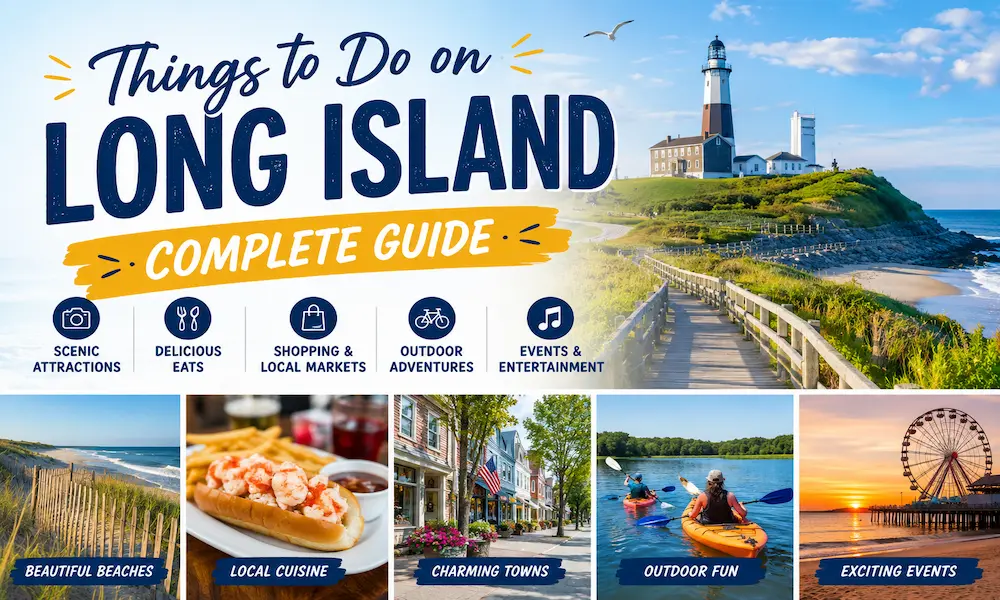
Long Island has a branding problem. Say the name to someone from out of town and they picture strip malls, the LIE at rush hour, and maybe the Hamptons if they’ve watched enough reality TV. Say it to someone who actually grew up here, and they’ll tell you about a place where you can watch the sunrise over the Atlantic, spend the afternoon tasting wine on a working vineyard, and be back in Manhattan in time for a late dinner, all in the same day.
That’s the real story of Long Island: 118 miles of coastline stretching from Brooklyn to Montauk, packed with more variety per square mile than almost anywhere else on the East Coast. Beaches that rank among the best in the country. Gilded Age mansions that inspired The Great Gatsby. Sixty-plus wineries. Fishing villages that haven’t changed much since the 1800s. And all of it within an hour or two of one of the biggest cities on earth.
This guide is built for people who actually want to go do these things, not just read a list. We’ll walk through what’s worth your time by region, when to go, what gets crowded, what’s worth skipping, and how to string a few stops together into a day that doesn’t feel rushed.
Why Long Island Deserves More Than a Day Trip
Most first-time visitors treat Long Island as a single afternoon excursion: drive out, hit one beach, drive back. That’s a mistake, because the island isn’t really one destination. It’s five or six distinct regions stitched together, each with its own personality.
The North Shore, often called the Gold Coast, is old money and rolling estates. The Hamptons and Montauk are the glamorous South Fork, all beach clubs and lighthouse views. The North Fork is the Hamptons’ quieter, more agricultural cousin, where the wineries outnumber the boutiques. The South Shore has the barrier beaches, including Jones Beach and Fire Island. And in between, there are dozens of small downtowns, from Port Jefferson to Sag Harbor, that reward anyone willing to park the car and walk around for an hour.
Understanding this layout matters because it changes how you plan. A trip focused on the North Fork’s wine country looks nothing like a beach day at Jones Beach, and both are completely different from a family day at Splish Splash. Pick your region first, then build around it.
If you’re coming out from the city or JFK and want to skip the logistics entirely, a private car service to Long Island is worth looking into. It removes the parking headaches and lets everyone in the group actually relax on the ride out, especially useful for wine tours, wedding weekends, or a group heading to the Hamptons for a few days.
The Best Beaches on Long Island
Long Island’s beaches aren’t interchangeable, and picking the wrong one for your group is the most common planning mistake people make.
Jones Beach State Park is the workhorse. It has six miles of oceanfront, a boardwalk, two pools, and enough parking fields that you can usually find a spot even on a busy Saturday if you arrive before 11 a.m. It’s also home to the Northwell at Jones Beach Theater, which hosts major concerts all summer, so check the schedule if you want to combine a beach day with a show.
Main Beach in East Hampton and Coopers Beach in Southampton consistently rank among the top beaches in the country, and the difference is obvious the moment you see them: wide, soft sand, cleaner water, and a backdrop of dune grass and historic shingle-style homes rather than boardwalk snack bars. Parking here is restrictive for non-residents in peak season, so plan on a taxi, rideshare, or a car service that can drop you right at the entrance instead of circling for a permit spot.
Fire Island is the wild card. There are no cars on most of the island, just a string of small communities you reach by ferry from Bay Shore, Sayville, or Patchogue. Robert Moses State Park at the western tip is car-accessible and family-friendly, while communities like Cherry Grove and the Pines have their own distinct, lively scene. Fire Island National Seashore also protects a genuinely wild stretch of dunes and maritime forest that most visitors never see because they never get off the main beach.
Long Beach, technically its own city rather than part of the town of Hempstead, has a two-mile boardwalk lined with cafes and surf shops, and it’s the easiest beach to reach by train from the city, making it a good option if you don’t want to deal with a car at all.
A practical note: Long Island beach parking fills up fast on summer weekends, and lifeguard hours vary by location and season, so check the specific park’s website the morning you go rather than assuming last year’s hours still apply.
Gold Coast Mansions and Gatsby History
The North Shore earned its “Gold Coast” nickname in the late 1800s and early 1900s, when industrialists and financiers built estates along the Long Island Sound that rivaled European palaces. F. Scott Fitzgerald lived in Great Neck while writing The Great Gatsby, and the fictional East Egg and West Egg are widely believed to be based on Sands Point and Great Neck.
Oheka Castle in Huntington is the most dramatic survivor of that era, a 127-room French chateau-style mansion that was once the second-largest private residence in the country. It now operates partly as a hotel and event venue, but public tours run on select days and are worth booking ahead.
Old Westbury Gardens pairs a Charles II-style mansion with 200 acres of formal gardens, and it’s genuinely one of the prettiest spots on the island in spring when the boxwood parterres and lilac walk are in bloom.
Planting Fields Arboretum in Oyster Bay combines a Tudor Revival mansion, Coe Hall, with greenhouses and a massive arboretum that’s particularly popular during camellia season in late winter, when most of the island is still gray and cold.
For a deeper dive into presidential history, Sagamore Hill, Theodore Roosevelt’s home in Oyster Bay, is now a National Historic Site run by the Park Service, with rangers who lead tours through the house exactly as the Roosevelt family left it.
The Hamptons and Montauk
The Hamptons get a reputation for being exclusive, and parts of it are, but the region is also full of things anyone can walk into for free. Sag Harbor’s Main Street is a genuinely charming former whaling village with independent bookstores and a working windmill. East Hampton and Southampton both have historic districts worth an hour of wandering, even if you’re not shopping.
Montauk, at the very tip of the island, has a completely different energy from the rest of the South Fork: surf shops instead of boutiques, fishing boats instead of yachts. The Montauk Point Lighthouse, commissioned by George Washington and completed in 1796, is the oldest lighthouse in New York State, and the small museum inside is worth the climb up for the view alone. Camp Hero State Park nearby has hiking trails through old military bunkers with dramatic ocean views, and it’s one of the few spots on Long Island that genuinely feels remote.
If you’re planning a Hamptons weekend and don’t want to fight beach-town parking or worry about someone driving back after a winery visit, renting a car once you’re out there is one option, but a lot of visitors find it’s actually easier and less stressful to book a car for the whole trip out and let a local driver handle the roads, the traffic on 27, and the drop-offs between towns.
North Fork Wine Country
If the Hamptons are Long Island’s see-and-be-seen side, the North Fork is its working-farm side, and it’s grown into a legitimate wine region over the last 40 years. More than 60 wineries now operate across Cutchogue, Peconic, Southold, and Greenport, most producing Bordeaux-style reds and crisp whites that do well with the region’s maritime climate.
A few worth building a day around: Pindar Vineyards, one of the oldest and largest on the island, Macari Vineyards, known for biodynamic farming and Sound-view tasting rooms, and Lieb Cellars, a smaller producer with a devoted following for its rosé. Most tasting rooms are open Thursday through Sunday year-round and daily in summer, but hours shift seasonally, so it’s worth checking ahead, especially in the off-season.
Between tastings, Greenport is the town to anchor a day around. It’s a working harbor with a restored 1920s carousel, seafood shacks right on the water, and a small but excellent maritime museum. From Greenport, the North Ferry connects to Shelter Island in about ten minutes, which is worth the detour if you have an extra hour, since it’s one of the least developed parts of the island, mostly nature preserve.
Because wine touring involves, well, wine, this is one of the areas where a lot of visitors specifically look for a car service rather than a rental. Nobody wants to be the designated driver on a day built around tastings, and having a driver who already knows the wineries means less time spent looking at maps and more time actually enjoying the visit.
Family-Friendly Attractions
Long Island punches well above its weight for family travel, largely because so many of its biggest draws were built with kids specifically in mind.
Splish Splash in Riverhead is consistently ranked among the best water parks in the country, with rides ranging from a toddler-friendly splash zone to the Mammoth River family raft ride and several genuinely fast slides for older kids and teens.
The Long Island Aquarium, also in Riverhead, blends education and entertainment well, with shark and sea lion encounters, a large coral reef exhibit, and even overnight stays where kids can sleep next to the shark tank.
The Cradle of Aviation Museum in Garden City tells the story of Long Island’s outsized role in aviation history, from Charles Lindbergh’s Spirit of St. Louis to the lunar module built by Grumman for the Apollo missions, and it’s paired with a planetarium that runs shows throughout the day.
For younger kids, the Long Island Children’s Museum in Garden City has hands-on exhibits built for exactly the age range that gets bored at traditional museums, and several of the North Fork farms, like Harbes Farm in Mattituck, run seasonal activities including hayrides, corn mazes, and pick-your-own fruit that work well for a half-day outing.
Culture, Museums, and Rainy-Day Plans
Not every day on Long Island is a beach day, and the island’s museum scene is deeper than most visitors expect. The Parrish Art Museum in Water Mill has one of the best collections of American art tied to a specific region anywhere in the country, focused on artists who worked on the East End, including Jackson Pollock and Willem de Kooning, who both lived and painted nearby.
The Nassau County Museum of Art in Roslyn occupies a former Gold Coast estate and pairs rotating exhibitions with 145 acres of grounds and sculpture gardens. In Huntington, the Heckscher Museum of Art is smaller but consistently well-curated, and it’s a manageable stop if you’re already in the area visiting Oheka Castle or the Vanderbilt Museum.
Speaking of the Vanderbilts: the Vanderbilt Museum and Planetarium in Centerport combines a 24-room Spanish Revival mansion built by William K. Vanderbilt II with a genuinely strong planetarium program, making it one of the better rainy-day options on the North Shore for families and history buffs alike.
Long Island by Season
Timing changes what’s worth doing here more than most destinations.
Spring (April to May) is when Old Westbury Gardens and Planting Fields hit peak bloom, and it’s shoulder season for pricing on wine tastings and hotels, before the summer crowds arrive.
Summer (June to August) is beach season, full stop, but it’s also when Jones Beach Theater’s concert calendar is busiest and when the North Fork’s farm stands are overflowing with strawberries, then peaches, then corn as the season progresses.
Fall (September to November) is arguably the best time to visit for people who want the scenery without the crowds. Wineries are at their busiest with harvest events, apple and pumpkin picking runs through the North Fork farms, and the Hamptons beaches empty out while the weather is still warm enough to enjoy them.
Winter (December to March) is quieter but not dead. Port Jefferson’s Charles Dickens Festival in early December is genuinely worth the trip, Planting Fields’ greenhouse camellias bloom when nothing else on the island is blooming, and several wineries run cozy indoor tastings that are actually more relaxed than their summer counterparts.
Building a Day Trip That Actually Works
The single biggest planning mistake is trying to cover too much ground. The North Fork and the Hamptons are both worth a full day on their own, and cramming both into one trip usually means spending more time in the car than at either destination.
A realistic North Fork day looks like: late morning in Greenport, two or three winery stops in the early-to-mid afternoon, and dinner back in Greenport or Southold before heading home. A Hamptons day works better anchored around one beach and one town, say Coopers Beach in the morning and a walk through Southampton’s Main Street in the afternoon, rather than trying to hit East Hampton, Sag Harbor, and Montauk in the same trip.
If you’re coming from Manhattan, Brooklyn, or one of the airports and don’t want to deal with Long Island’s summer traffic on your own, this is exactly the kind of trip a private car and driver handles well. It’s also worth checking a limousine service built specifically for Long Island if you’re planning something larger, like a group heading out for a wedding weekend, a wine tour with six or eight people, or a family trip where nobody wants to be stuck driving after a long beach day.
For groups flying in specifically to explore the island, it’s worth arranging transportation directly from the airport rather than adding a rental car pickup to the trip. A car service that already knows the drive out to the East End can save real time compared to figuring out the Long Island Expressway for the first time.
Frequently Asked Questions
What is Long Island best known for?
Long Island is best known for its beaches, including the Hamptons and Fire Island, its Gold Coast mansions from the Gilded Age, and the North Fork’s wine country, which has grown into one of the East Coast’s most respected wine regions.
How many days do you need to see Long Island?
A weekend covers the highlights of one region, like the Hamptons or the North Fork. Seeing the island properly, including the North Shore mansions, South Shore beaches, and East End, realistically takes four to five days.
Is Long Island worth visiting if you’re already in New York City?
Yes. Several beaches and North Shore towns are under 90 minutes from Manhattan, and even Montauk, at the far eastern tip, is roughly a three-hour drive, making it possible to see a genuinely different side of New York without a long-haul trip.
What’s the best time of year to visit Long Island?
Late September through October offers the best combination of good weather, wine harvest events, and thinner crowds than peak summer. For beach-focused trips, July and August are the classic window, though they’re also the busiest.
Do you need a car to get around Long Island?
For most of the island, yes, since public transit is limited outside the LIRR corridor into towns. Many visitors, especially those touring wineries or heading to multiple beach towns in one trip, book a car service instead of a rental to avoid parking and driving after tastings.
Planning Your Trip
Long Island rewards people who slow down and pick a region rather than trying to see everything in one pass. Whether that means a wine-tasting day on the North Fork, a beach weekend in the Hamptons, or a family day at Splish Splash and the Long Island Aquarium, the trip works best when the logistics are handled before you even leave the driveway.
If you’re planning a visit from the city, the airports, or anywhere else in the region, All Comfort Limo’s Long Island service can get your group out to the North Fork, the Hamptons, or anywhere in between without anyone having to worry about traffic on the LIE or where to park. For groups planning something bigger, like a wedding weekend or a milestone celebration out east, it’s worth looking at options for special events transportation that can handle multiple stops in a single day. And if you’re flying in specifically for a Long Island trip, arranging JFK airport transportation ahead of time means your trip starts the moment you land, not an hour later at a rental counter.
Whichever region you pick first, you’ll probably end up planning a second trip before you’ve even finished the first one. That’s how it tends to go out here.